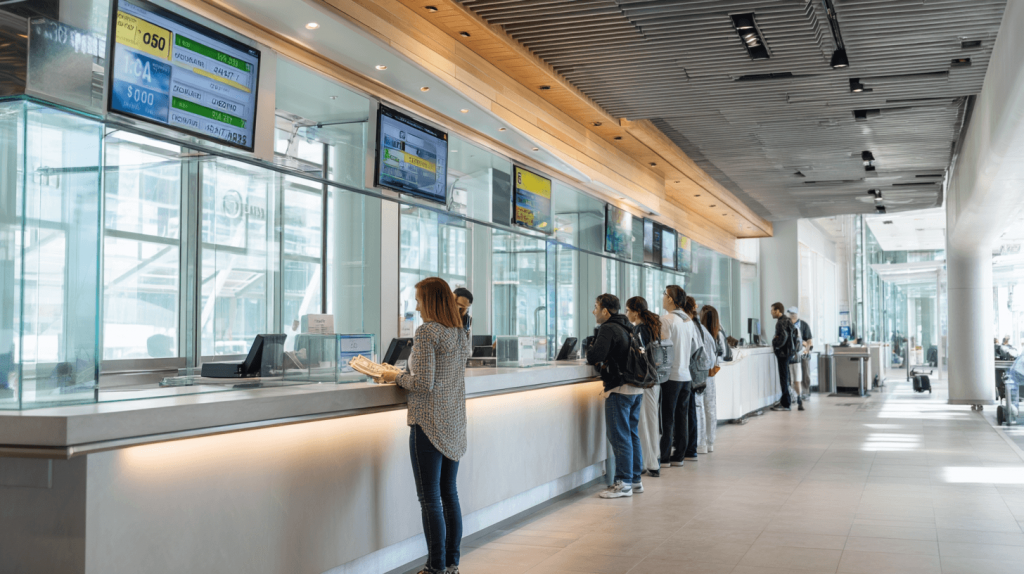
You’re at Calgary International Airport, excited about your upcoming vacation to Europe or the United States. As you pass through the terminal, you notice a currency exchange kiosk advertising “convenient” foreign currency services. Your flight boards in an hour, and you realize you haven’t exchanged any money yet. Should you stop and exchange now, or should you have planned differently?
This common scenario costs Calgary travelers thousands of dollars collectively every day. Airport currency exchange represents one of the most expensive financial transactions most people ever make, with markups ranging from 5% to 8% above fair market rates—sometimes even higher. On a typical $2,000 vacation exchange, this convenience can cost you $100 to $160 that could have been spent on an extra nice dinner, an attraction ticket, or simply kept in your bank account.
The good news? With minimal planning, Calgary travelers can avoid these excessive costs entirely. This guide compares all your currency exchange options—from the expensive convenience of YYC airport kiosks to downtown Calgary banks to online currency exchange—helping you make informed decisions that keep more money in your travel budget where it belongs.
The Truth About Calgary Airport Currency Exchange
Understanding what you’re actually paying at Calgary International Airport helps contextualize why advance planning saves substantial money.
Currency Exchange Options at YYC
Calgary International Airport maintains currency exchange services in both the domestic and international terminals. These kiosks typically operate extended hours to accommodate early morning and late evening flights, offering major currencies including U.S. dollars, euros, British pounds, Mexican pesos, and other common travel currencies.
The services appear convenient—you can exchange money immediately before departure or upon return, the process takes just a few minutes, and multiple currency options are available in one location. However, this convenience comes at an extraordinary premium that few travelers fully understand until they calculate the true cost.
The Real Cost of Airport Exchange
Airport currency exchange kiosks typically mark up rates 5% to 8% above the mid-market exchange rate. Some Calgary travelers report markups exceeding 10% during peak travel seasons or for less common currencies. To understand what this means in real dollars, consider a typical example.
If the mid-market USD/CAD rate is 1.3500, you should theoretically receive $1,350 USD for $1,000 CAD. However, a Calgary airport exchange kiosk might offer a rate of 1.2825, giving you only $1,282 USD—a loss of $68. On a $2,000 CAD exchange, you’re losing $136. For a family exchanging $5,000 CAD for a significant vacation, the airport premium costs $340.
Beyond the exchange rate markup, some airport kiosks charge additional commission fees of 2% to 5% or flat fees of $5 to $10 per transaction. These fees compound the rate markup, creating total costs that can exceed 10% of your exchange amount.
Why are airport rates so poor? The business model relies on captive customers with no alternatives and immediate needs. Airport kiosks pay premium rent, operate extended hours, maintain inventory of multiple currencies, and face limited competition—all costs passed directly to travelers through inflated rates.
When Airport Exchange Makes Sense
Despite the high costs, Calgary airport currency exchange does make sense in specific limited circumstances. If you experience a genuine emergency—forgot to exchange entirely, your original exchange fell through, or you’re helping a fellow traveler in need—the convenience may justify the premium.
For very small amounts needed immediately upon arrival—$20 to $50 for taxi fare, tips, or immediate purchases before reaching an ATM—the absolute dollar cost of poor rates is minimal. Losing $5 on a $50 exchange, while regrettable, won’t ruin your trip.
Occasionally, you might need an obscure currency unavailable elsewhere in Calgary on short notice. In these rare cases, airport exchange may be your only option, though this situation is increasingly uncommon as online currency services expand their offerings.
For 95% of Calgary travelers in 95% of situations, airport currency exchange should be avoided entirely through simple advance planning.
Downtown Calgary Currency Exchange Locations
For travelers who prefer in-person transactions but want better rates than the airport, downtown Calgary offers several alternatives.
Banks in Downtown Calgary
Major Canadian banks—TD, RBC, BMO, CIBC, and Scotiabank—maintain numerous branches throughout downtown Calgary, including convenient locations on Stephen Avenue, in Banker’s Hall, and throughout the downtown core. Most banks offer foreign currency exchange to account holders and sometimes to non-customers with identification.
Bank exchange rates run approximately 2.5% to 3.5% above mid-market rates—significantly better than airport kiosks but still substantially worse than specialized currency exchange providers. On a $2,000 exchange, bank rates typically cost $50 to $70 more than competitive alternatives.
Banks may require appointments for larger currency exchanges or less common currencies, as branches don’t maintain extensive foreign currency inventory. This planning requirement means you’re already thinking ahead, which begs the question: if you’re planning enough to visit a bank branch, why not plan slightly further ahead and use even better online rates?
Processing can be slow, particularly during busy periods. A bank visit for currency exchange often consumes 30 to 45 minutes between travel time, waiting, and transaction processing—time that could be spent on actual travel preparation or work.
The Convenience vs. Cost Trade-off
Downtown Calgary currency exchange locations offer a middle ground: better than airport rates, worse than online exchange. For some travelers, particularly those uncomfortable with online financial transactions, this compromise provides peace of mind despite higher costs.
Consider your personal values and comfort level. If physically handling your foreign currency before travel provides psychological comfort worth $50 to $100, and you have time to visit a downtown location, this option may suit your needs. However, for most Calgary travelers, the modest convenience advantage doesn’t justify the significant cost difference compared to online exchange.
Online Currency Exchange: The Smart Alternative
Online currency exchange has revolutionized how savvy Calgary travelers prepare for international trips, offering the best combination of rates, convenience, and security.
How Online Currency Exchange Works
The online exchange process is straightforward and typically takes less than 15 minutes for first-time users, with subsequent exchanges taking just a few minutes. You register on a FINTRAC-regulated currency exchange website, providing basic identification and banking information. This one-time setup meets federal anti-money laundering requirements.
Once registered, you request a rate quote for your desired currency and amount. Rates are typically locked for 15 minutes to several hours, depending on the provider, giving you time to complete the transaction. You initiate a transfer from your Calgary bank account to the currency exchange provider via wire transfer, online banking, or e-transfer.
Within one to three business days, the converted foreign currency is deposited directly to your bank account, or delivered to your Calgary address for a small fee if you prefer physical cash. The entire process happens without visiting any physical location, often while you’re completing other travel preparation tasks.
Why Online Rates Beat Physical Locations
Online currency exchange providers operate with dramatically lower overhead than airport kiosks or bank branches. Without expensive retail locations, extensive staff, or high inventory carrying costs, these companies pass savings directly to customers through better exchange rates.
Typical online exchange rates run 1% to 1.5% above mid-market rates for major currencies—compared to 2.5% to 3.5% for banks and 5% to 8% for airports. This difference translates to substantial real savings on every exchange.
Consider a typical $2,000 CAD exchange to USD with an assumed mid-market rate of 1.3500. An airport kiosk might offer 1.2825, yielding $1,282 USD. A Calgary bank might offer 1.3095, yielding $1,309 USD. An online currency exchange in Calgary might offer 1.3365, yielding $1,337 USD.
The difference between airport and online exchange is $55 USD—enough for multiple meals or attractions on your trip. The difference between bank and online exchange is $28 USD—not life-changing, but meaningful savings for simply planning a few days earlier.
Security and Regulation
A common misconception holds that online currency exchange is less secure than traditional banks or physical locations. In reality, FINTRAC-regulated online currency exchange providers maintain identical security standards to Canadian banks.
These providers must hold client funds in segregated accounts at major Canadian financial institutions, implement robust identity verification and anti-money laundering procedures, maintain detailed transaction records available for regulatory review, and comply with all federal regulations governing money services businesses.
Reputable online currency exchange providers also maintain strong online security through encrypted connections, secure authentication, and regular security audits. Your funds are protected throughout the exchange process by the same regulatory framework that governs banks.
Delivery Options for Calgary Travelers
Online currency exchange offers flexible delivery suited to different travel preparation timelines. Standard delivery deposits converted currency directly to your Calgary bank account within two to three business days. This works perfectly for travelers planning at least a week ahead—the situation for most international trips.
For travelers who prefer physical cash, some providers offer courier delivery to your Calgary address. This service typically includes a delivery fee of $10 to $30 depending on amount and urgency but still costs less than airport or bank exchange for moderate to large amounts.
Some online providers offer same-day or next-day service for urgent needs, though rates may be slightly less favorable for expedited service. Even with urgency premiums, online exchange typically beats physical location rates while providing convenience that rivals airport kiosks.
Complete Cost Comparison: Real Numbers
Abstract percentages become meaningful when translated to actual dollars you’ll save or lose based on your exchange choice.
Scenario 1: Europe Vacation ($2,000 CAD to EUR)
Sarah is planning a two-week Europe trip and needs to exchange $2,000 CAD to euros. Assuming a mid-market rate where $2,000 CAD equals €1,370:
YYC Airport Exchange: With 7% markup plus $10 commission fee, Sarah receives approximately €1,274. Total cost: €96 (equivalent to about $135 CAD).
Downtown Calgary Bank: With 3% markup, Sarah receives approximately €1,329. Total cost: €41 (equivalent to about $58 CAD).
Online Currency Broker: With 1.2% markup, Sarah receives approximately €1,354. Total cost: €16 (equivalent to about $23 CAD).
Total Savings: By choosing online exchange over the airport, Sarah saves €80—enough for multiple meals, museum entries, or local experiences. Even compared to her bank, online exchange saves €25, covering a nice lunch in Paris or Rome.
Scenario 2: Business Trip ($5,000 CAD to USD)
Marcus, a Calgary business consultant, needs $5,000 USD for a week-long conference in Chicago. With mid-market rate of 1.3500 ($5,000 CAD = $3,704 USD):
YYC Airport Exchange: With 6% markup, Marcus receives approximately $3,482 USD. Total cost: $222 USD lost.
Downtown Calgary Bank: With 2.8% markup, Marcus receives approximately $3,600 USD. Total cost: $104 USD lost.
Online Currency Broker: With 1% markup, Marcus receives approximately $3,667 USD. Total cost: $37 USD lost.
Total Savings: Marcus saves $185 USD choosing online over airport exchange—enough to cover several business meals or upgrade his hotel. Even versus his bank, he saves $67 USD, covering ground transportation for the week.
Scenario 3: Emergency Travel ($500 CAD needed quickly)
Jennifer needs $500 USD urgently for unexpected family travel to the United States departing tomorrow.
YYC Airport Exchange: With 7% markup, Jennifer receives approximately $346 USD. Total cost: $24 USD lost.
Calgary Bank (if time permits): With 3% markup, Jennifer receives approximately $358 USD. Total cost: $12 USD lost.
Online with Expedited Service: With 1.5% markup plus $15 urgency fee, Jennifer receives approximately $364 USD. Total cost: $6 USD plus $15 fee = $21 total.
Analysis: Even in emergency situations, online exchange often provides better value. While the absolute savings are smaller on modest amounts, every dollar matters in stressful situations. The key insight: even one day of planning makes a difference.
How Much Cash Do You Actually Need in 2025?
Before focusing entirely on exchange rates, consider whether you need as much cash as you think. Modern payment technology has dramatically reduced cash requirements for most international travel.
The Reality of Modern Travel
Credit cards are accepted almost everywhere travelers typically visit, from major international airports to small cafes in European villages. Contactless payment technology—tap to pay—has spread globally, making card transactions faster and more convenient than cash in many situations.
Most hotels, airlines, car rentals, and major attractions require credit cards regardless of whether you have cash. Many establishments, particularly in Scandinavia and increasingly elsewhere, prefer or exclusively accept card payments.
While cash remains necessary for certain transactions—street vendors, small local restaurants, tips, public transportation in some cities, and emergency backup—the amounts needed are substantially less than many Calgary travelers assume.
Recommended Cash Amounts by Destination
For Europe, $200 to $300 equivalent in local currency covers emergencies and situations where cards aren’t accepted. This amount handles tips, small purchases, and transportation for a typical one to two-week trip, with cards covering major expenses.
United States travel requires minimal cash—$100 to $200 is generous for most trips, as U.S. card acceptance rivals Canada. The main exception is tipping, where cash is preferred though increasingly unnecessary as digital tipping expands.
Asia varies significantly by country. Japan, South Korea, and Singapore are increasingly cashless, while other Southeast Asian countries still rely heavily on cash. Research your specific destination, but $400 to $600 often suffices even for cash-preferring countries.
Latin America generally requires more cash than Europe or Asia. $500 to $800 equivalent provides comfort, though this varies widely by specific country and whether you’re in major cities or rural areas.
Credit Card Foreign Transaction Fees
Many Canadian credit cards charge foreign transaction fees of 2.5% on all international purchases—similar to moderate exchange rate markups. However, numerous travel-focused credit cards eliminate these fees entirely, making them cost-effective for the majority of your travel spending.
Cards with no foreign transaction fees essentially give you wholesale exchange rates on every purchase—far better than cash exchange through any method. Popular options include various premium travel rewards cards that also provide insurance, lounge access, and other travel benefits.
The optimal strategy for most Calgary travelers: exchange a modest amount of cash through competitive online currency exchange for essentials and emergencies, and use a no-foreign-transaction-fee credit card for the majority of purchases.
Pre-Travel Currency Exchange Checklist for Calgary Residents
Systematic preparation eliminates last-minute stress and costly airport exchanges. This timeline helps you optimize your travel currency strategy.
2-3 Weeks Before Travel:
Begin researching your destination’s actual cash needs by reading recent travel reports and forums. Compare current exchange rates across different Calgary providers including online brokers, banks, and noting airport rates to understand the cost spread. If you haven’t used online currency exchange before, register and verify your account, as this one-time process takes a few days for identity verification.
1 Week Before Travel:
Initiate your currency exchange through your chosen provider—ideally an online broker with competitive rates. Verify delivery timing to ensure foreign currency arrives before your departure. This is also when you should notify credit card companies of your travel dates and destinations to prevent fraud blocks on legitimate purchases abroad.
2-3 Days Before Travel:
Confirm the converted foreign currency has been deposited to your bank account or delivered to your Calgary address. Organize cash for security—avoid keeping all currency in one place, consider a travel money belt for large amounts, and keep some small bills separate for immediate arrival needs like tips or taxis. Prepare and test all backup payment methods including multiple credit cards, noting customer service numbers for each.
At Calgary Airport:
Keep your money in your pocket! You’ve planned ahead and have appropriate currency at far better rates. Only exchange at YYC if facing a genuine emergency—and even then, exchange the absolute minimum necessary.
What About Exchanging Leftover Foreign Currency After Your Trip?
The often-forgotten aspect of travel currency planning is what to do with leftover foreign cash when you return to Calgary.
Exchanging foreign currency back to Canadian dollars typically involves even worse rates than the original exchange. Airport buy-back rates can exceed 10% to 12% markups—they know you’re departing and have few alternatives. On $200 USD leftover currency, you might lose $20 to $25 in the exchange back process.
Better options exist for Calgary residents. If you travel to the same region regularly or semi-regularly, hold the foreign currency for your next trip—money doesn’t expire. Store it securely at home and you’ll save both directions on your next journey.
For larger amounts, online currency exchange providers offer better buy-back rates—though still less favorable than original purchase rates, the spread is narrower than airport or bank options. This makes sense if you’re unlikely to use that currency again and the amount justifies the effort.
Before leaving your destination, try to spend down foreign currency on final purchases, airport refreshments, or charitable donations. This maximizes value and eliminates the need for less-favorable buy-back exchanges.
Special Considerations for Calgary Travelers
Calgary’s unique position and demographics create specific currency exchange considerations for certain travel patterns.
Cross-Border Shopping in the US
Many Calgary residents travel to the United States for shopping, particularly to Montana for major purchases. For these trips, the question becomes whether you need USD cash at all. Nearly every U.S. retailer accepts Canadian credit cards, often with better effective exchange rates than cash once you factor in exchange markups.
For cross-border shopping trips, minimize cash needs and rely primarily on a credit card without foreign transaction fees. Exchange only enough USD to cover meals, gas, and other cash-only situations—typically $100 to $200 for a weekend shopping trip.
Snowbird Season Planning
Calgary snowbirds heading to Arizona, California, Florida, or other warm destinations for extended winter stays face different currency needs. A four-month stay requires substantially more currency than a one-week vacation.
For snowbirds, the strategy shifts to larger bulk exchanges at the best possible rates, timing exchanges over several months if possible to average out rate fluctuations, and maintaining both USD and CAD accounts to preserve flexibility. Some snowbirds keep USD accounts in both Canadian and U.S. banks, converting only as needed throughout their stay rather than exchanging their entire season budget upfront.
Business Travel Currency Management
Calgary business travelers often face corporate policies dictating currency exchange methods, company credit cards covering most expenses, and detailed expense reporting requiring receipts. Even within these constraints, choosing better exchange rates for personal currency needs—tips, personal meals, or extending business trips for leisure—saves money.
Common Travel Currency Exchange Mistakes
Even experienced Calgary travelers make costly currency exchange errors that drain their travel budgets unnecessarily.
Exchanging at the last minute remains the most common and expensive mistake. Whether at the airport, scrambling the day before departure, or during your trip at poor local rates, last-minute exchanges always cost more. Plan at least one week ahead for optimal rates and stress-free preparation.
Converting your entire travel budget means over-estimating cash needs and paying exchange costs on money you’ll eventually need to change back at worse rates. Calculate realistic cash requirements based on modern payment technology and your specific destination. Exchange 30% to 50% less than your instinct suggests—you can always access ATMs abroad if truly needed, and ATM fees often beat poor exchange rates.
Using airport exchange kiosks except in genuine emergencies wastes money. Those bright signs advertising “convenient” currency exchange are expensive traps for unprepared travelers. Walk past them confidently, knowing your advance planning saved substantial money.
Not comparing rates means accepting whatever your bank offers without understanding the cost. Spending 15 minutes comparing rates across providers can save $50 to $200 on typical vacation exchanges—exceptional return on time invested.
Forgetting about credit card options causes travelers to carry excessive cash unnecessarily. Modern travel rewards cards with no foreign transaction fees provide better effective exchange rates than even the best cash exchange providers for the majority of your spending.
Carrying too much cash for security creates unnecessary risk. While you need some cash, carrying large amounts makes you a target for theft and creates stress throughout your trip. Exchange modest amounts and rely on secure payment methods for larger expenses.
Not having small bills for tips creates awkward situations and often results in over-tipping out of necessity. When exchanging, request some small denominations specifically for tips and minor purchases rather than only large bills.
Why Calgary Travelers Choose CanAm Currency Exchange
Calgary travelers preparing for international trips increasingly turn to CanAm Currency Exchange for cost-effective, secure foreign currency needs.
The savings start immediately with rates 1.5% to 2% better than banks and dramatically better than YYC airport kiosks. On a typical $2,000 Europe vacation exchange, this means keeping an extra $100 to $140 in your travel budget—enough for multiple memorable meals or attractions you might otherwise skip.
We make the planning process simple with an easy online platform accessible from anywhere in Calgary, fast delivery directly to your bank account (typically 1-2 business days), and the ability to order multiple currencies for multi-country trips in a single transaction. No visits to branches, no waiting in lines, no wasting precious pre-travel time.
As a FINTRAC-regulated money services business, we provide bank-level security with segregated client accounts at major Canadian financial institutions and full regulatory compliance. Your foreign currency exchange receives the same legal protections as traditional banking, without the poor rates banks charge.
Our currency specialists understand travel needs and provide personalized guidance on how much cash you actually need for specific destinations, timing strategies if your travel dates are flexible, and realistic expectations about modern payment technology abroad. We’ve helped thousands of Calgary travelers optimize their currency exchange, and we understand the questions and concerns you’re facing.
Whether you’re planning a European adventure, U.S. business trip, Asian exploration, or any international travel, we deliver better rates, simple process, secure transactions, and expert guidance. Visit CanAm Currency Exchange or call 1-844-915-5151 to get a free quote and experience the difference advance planning with competitive rates makes for your travel budget.
Conclusion
The decision of where to exchange currency for your Calgary departure is straightforward when you understand the true costs. Airport exchange kiosks at YYC represent the worst option almost universally, costing 5% to 8% above fair rates. Banks provide moderate improvement at 2.5% to 3.5% markups but still leave substantial money on the table. Online currency exchange delivers the best combination of rates (typically 1% to 1.5% above mid-market), convenience, and security.
For the typical Calgary traveler exchanging $1,500 to $3,000 for an international trip, choosing wisely saves $100 to $200 or more—meaningful money that enhances your travel experience rather than disappearing into exchange markups.
The action steps are simple: start planning your currency exchange at least one week before travel, compare rates across providers and calculate true costs including all markups and fees, choose a FINTRAC-regulated online currency exchange provider, and exchange only the modest amount of cash you actually need while relying on fee-free travel credit cards for major expenses.
For your next international trip from Calgary, plan ahead and exchange smart. Get a free quote from CanAm Currency Exchange at 1-844-915-5151 and see exactly how much you’ll save compared to airport or bank exchanges. Your travel budget will thank you, and you’ll wonder why you ever considered last-minute airport exchange in the first place.