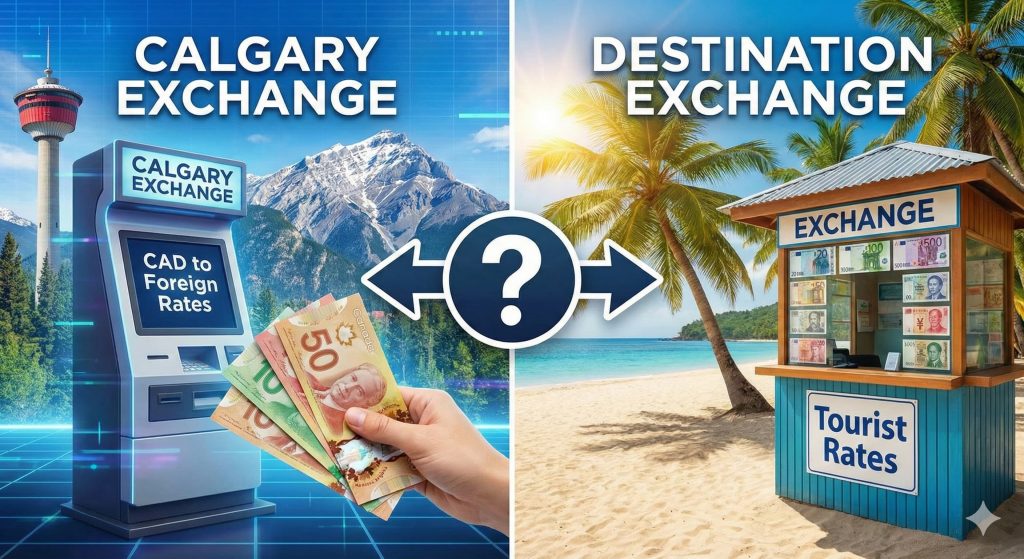
Every Calgary traveler faces this question before an international trip: should you exchange currency before leaving, or wait until you arrive at your destination? The answer isn’t one-size-fits-all—it depends on where you’re going, how you plan to spend, and how much effort you’re willing to put into optimizing your travel budget.
This guide breaks down the real costs and trade-offs of each approach, helping you make an informed decision that keeps more money in your pocket for the experiences that matter.
The Short Answer
For most Calgary travelers, the smartest approach combines both strategies: exchange a moderate amount of currency before leaving (enough for your first day or two), then supplement with ATM withdrawals or card payments abroad. This hybrid method balances convenience, cost-effectiveness, and security.
However, the optimal mix varies significantly based on your destination, travel style, and banking setup. Let’s explore each option in detail.
Option 1: Exchange Currency in Calgary Before You Leave
Exchanging currency before departure means you arrive at your destination with local money already in your pocket. For Calgary residents, this typically means using your bank, a specialized currency exchange provider, or—if you’re running late—the airport.
The Advantages of Exchanging in Calgary
Immediate purchasing power upon arrival. When your plane touches down, you’re ready. Need a taxi from the airport? Want to tip the porter? Craving a coffee while waiting for your hotel room? Having local currency means you’re not scrambling to find an ATM or hoping your card works at unfamiliar terminals.
This convenience matters most in destinations where cash remains king. Japan, Germany, and many Southeast Asian countries still rely heavily on cash transactions, particularly for smaller purchases, local markets, and transportation.
Rate certainty and budget control. When you exchange before leaving, you know exactly how much foreign currency you’re getting for your Canadian dollars. This makes budgeting straightforward—you can allocate specific amounts for meals, activities, and shopping without worrying about rate fluctuations during your trip.
Avoiding destination exchange pitfalls. Currency exchange services at airports abroad are notoriously expensive, often charging markups of 8% to 15% above fair market rates. Hotel exchange desks are similarly costly. By exchanging in Calgary through a reputable provider, you sidestep these tourist traps entirely.
Reduced stress in unfamiliar environments. Navigating an ATM in a foreign language, dealing with unfamiliar banking systems, or hunting for exchange bureaux in an unfamiliar city adds friction to your travel experience. Having currency sorted before departure eliminates this hassle.
The Disadvantages of Exchanging in Calgary
Carrying cash creates risk. The more currency you carry, the more you stand to lose if your wallet is stolen or you misplace it. This security concern is legitimate, particularly in destinations with higher pickpocket activity.
Leftover currency is wasteful. If you exchange too much, you’ll return home with foreign cash that needs to be converted back—typically at worse rates than you paid originally. Every round-trip conversion costs money.
Exchange rates vary significantly by provider. Not all Calgary currency exchange options are created equal. Airport kiosks charge premiums of 5% to 8%, banks typically mark up rates by 2.5% to 3.5%, and specialized currency exchange providers offer rates closer to mid-market. Choosing the wrong provider erases much of the advantage of exchanging before you leave.
Cost Comparison: Calgary Exchange Options
| Exchange Method | Typical Markup | You Receive on $1,500 CAD to USD |
|---|---|---|
| YYC Airport kiosk | 6% – 8% | ~$1,020 – $1,040 USD |
| Calgary bank branch | 2.5% – 3.5% | ~$1,065 – $1,080 USD |
| Online currency specialist | 1% – 1.5% | ~$1,090 – $1,095 USD |
Rates are illustrative based on typical markups above mid-market rate. Actual amounts vary with daily exchange rates.
Option 2: Get Currency at Your Destination
Waiting until you arrive gives you access to local ATMs, banks, and exchange services. For some travelers and destinations, this approach can be cost-effective—but it comes with important caveats.
Using ATMs Abroad
ATMs typically offer exchange rates close to the interbank (mid-market) rate, which sounds attractive. However, the actual cost depends heavily on the fees your Canadian bank charges for international withdrawals.
What Canadian banks charge for foreign ATM withdrawals:
| Bank | International ATM Fee | Foreign Exchange Fee | Total Cost on $200 CAD Withdrawal |
|---|---|---|---|
| RBC | $3 (US) / $5 (other) | 2.5% | $8 – $10 |
| TD Canada Trust | $3 (US) / $5 (other) | 2.5% | $8 – $10 |
| BMO | $5 | 2.5% | $10 |
| CIBC | $3 (US) / $5 (other) | 2.5% | $8 – $10 |
| Scotiabank (Global ATM Alliance) | $0 at partner ATMs* | 2.5% | $5* |
*Scotiabank waives ATM access fees at Global ATM Alliance partner banks in 40+ countries, but the 2.5% foreign exchange fee still applies. Partner ATM operators may also charge their own convenience fees.
On a typical $200 CAD equivalent withdrawal, you’re paying $8 to $10 in combined fees—roughly 4% to 5% of the transaction. Make four withdrawals during a two-week trip, and those fees add up to $32 to $40.
The ATM Advantages
Withdraw only what you need. ATMs let you access cash incrementally, reducing the risk of carrying large amounts and eliminating leftover currency problems. Need another $100 for an unexpected expense? Just find an ATM.
Widespread availability. ATMs are ubiquitous in most tourist destinations. Canada, the US, Western Europe, Australia, and Japan all have extensive ATM networks. You’re rarely more than a few blocks from cash access in major cities.
Potentially good exchange rates. ATM withdrawals typically use wholesale exchange rates set by Visa or Mastercard networks, which are close to mid-market rates. The rate itself is usually fair—it’s the fees that erode value.
The ATM Disadvantages
Fees compound quickly. Between your bank’s international ATM fee, their foreign exchange markup (typically 2.5%), and potential ATM operator surcharges, costs add up—especially with multiple small withdrawals.
Dynamic Currency Conversion traps. Many foreign ATMs offer to convert your withdrawal to Canadian dollars for you. This “convenience” typically adds 3% to 4% to your costs through unfavorable exchange rates. Always choose to be charged in the local currency and let your Canadian bank handle the conversion.
Not all destinations have reliable ATM access. While ATMs are plentiful in developed countries, coverage becomes spotty in rural areas, smaller towns, and some developing nations. Nepal, for instance, has only about 20 ATMs per 100,000 adults. Running out of cash with no ATM in sight is stressful.
Card holds and freezes. Even with travel notifications, Canadian banks sometimes flag foreign transactions as suspicious and freeze cards. Being stranded abroad without ATM access is a nightmare scenario—one that carrying backup cash prevents.
Using Exchange Services Abroad
Currency exchange bureaux exist at airports, train stations, and tourist areas worldwide. Unfortunately, these services typically offer the worst rates available—markups of 8% to 15% are common at airport locations, and even street-level exchanges in tourist zones charge significant premiums.
The one exception: local banks in your destination country sometimes offer reasonable rates, particularly in countries with less developed ATM infrastructure. However, this requires research, language skills, and time you might prefer spending on vacation activities.
Destination-Specific Considerations
The optimal strategy varies based on where you’re traveling. Here’s guidance for popular destinations from Calgary:
United States
Card acceptance is nearly universal, and USD is easy to obtain in Calgary at competitive rates. Exchange enough for tips and small cash purchases before leaving, then rely primarily on credit cards. TD Canada Trust customers can use TD Bank ATMs in the eastern US with reduced fees.
Mexico
Cash remains important for smaller purchases, taxis, and tips. Exchange some pesos before leaving (or bring USD, which is widely accepted in tourist areas), then supplement with ATM withdrawals from reputable bank ATMs (avoid standalone machines in convenience stores). Scotiabank has extensive Mexican operations through its Global ATM Alliance membership.
Western Europe (UK, France, Germany, etc.)
Card acceptance is excellent in cities, but Germany especially remains cash-oriented for smaller purchases. Exchange euros or pounds before leaving for immediate expenses, then use ATMs or cards as needed. Scotiabank’s Global ATM Alliance includes Barclays (UK) and BNP Paribas (France).
Japan
Japan is heavily cash-based despite being technologically advanced. Many restaurants, shops, and transportation services don’t accept foreign cards. Exchange a significant portion of your budget to yen before leaving Calgary, as this is one destination where having ample cash truly matters.
Southeast Asia (Thailand, Vietnam, etc.)
ATMs are widely available in tourist areas, but fees can be steep—Thai ATMs often charge 220 baht (~$9 CAD) per withdrawal on top of your bank’s fees. Exchange some currency before leaving for arrival expenses, but be aware that exotic currencies may need to be ordered in advance.
Caribbean
US dollars are widely accepted throughout the Caribbean, and USD is readily available in Calgary. Credit cards work at resorts and larger establishments, but cash is essential for local vendors, tips, and smaller businesses.
The Smart Hybrid Strategy
For most Calgary travelers, combining pre-departure exchange with destination access works best. Here’s a practical framework:
Before You Leave Calgary
- Exchange enough for 2-3 days of expenses. Calculate realistic costs for airport transportation, first meals, tips, and incidentals. For most destinations, $200 to $400 CAD equivalent provides comfortable cushion.
- Use a specialized currency exchange provider. Online currency specialists typically offer rates 1% to 2% better than banks and 5% to 7% better than airport kiosks. The savings add up on larger exchanges.
- Avoid YYC airport exchange except for emergencies. Airport rates are consistently the worst available. Even a quick downtown stop or online order saves meaningful money.
While Traveling
- Use credit cards with no foreign transaction fees for major purchases. Cards like the Scotiabank Passport Visa Infinite or Rogers World Elite Mastercard eliminate the 2.5% foreign transaction fee most cards charge.
- Make fewer, larger ATM withdrawals. If you need cash, withdraw enough for several days rather than making daily small withdrawals. This minimizes the impact of flat-fee charges.
- Always choose local currency at ATMs. When prompted, decline the ATM’s offer to convert to Canadian dollars. Dynamic Currency Conversion costs you 3% to 4% extra.
- Keep backup payment methods separate. Store emergency cash and a backup card separately from your daily wallet. If one is lost or stolen, you’re not stranded.
Common Mistakes Calgary Travelers Make
Exchanging at the last minute at YYC. Airport exchange should be your absolute last resort, not your default plan. The convenience costs $50 to $100+ on typical vacation amounts.
Not notifying their bank of travel plans. Card freezes abroad are common when banks detect unexpected foreign transactions. A quick call or app notification prevents this hassle.
Converting entire travel budget to cash. This creates theft risk and leftover currency problems. Exchange what you’ll realistically need in cash; rely on cards for the rest.
Accepting Dynamic Currency Conversion. Whether at ATMs or point-of-sale terminals, always pay in local currency. The “convenience” of seeing Canadian dollars costs 3% to 4% extra.
Using credit cards for ATM cash advances. Credit card cash advances incur immediate interest charges (often 20%+) plus fees. Use debit cards for ATM withdrawals.
Exchanging at hotel front desks. Hotel exchange rates are almost as bad as airports. The convenience isn’t worth the 8% to 12% markup.
The Bottom Line: Exchange in Calgary—But Do It Right
For most Calgary travelers, exchanging currency before departure offers the best combination of value, convenience, and peace of mind—provided you use the right provider. Online currency exchange specialists consistently offer rates 4% to 7% better than airport kiosks and 1% to 2% better than banks.
The key is planning ahead. Last-minute airport exchange erases all potential savings, while advance preparation maximizes every dollar in your travel budget.
Get Better Rates on Your Travel Currency
At CanAm Currency Exchange, we help Calgary travelers get more from their money. Our online platform offers competitive exchange rates that beat banks and airport kiosks, with the convenience of ordering from home.
- Rates that save you money: Our exchange rates are consistently better than Calgary banks
- Wide currency selection: Access to major and exotic currencies for destinations worldwide
- Simple online ordering: Complete your exchange in minutes, no branch visit required
- FINTRAC regulated: Full regulatory compliance and bank-level security
- Personal service: Questions? Call us at +1 (844) 915-5151
Don’t lose money to poor exchange rates on your next trip. Plan ahead and exchange your currency the smart way.
→ Order Your Travel Currency Online
Frequently Asked Questions
How much currency should I exchange before leaving Calgary?
A good rule of thumb is exchanging enough for 2-3 days of cash expenses—typically $200 to $400 CAD equivalent for most destinations. This covers airport transportation, initial meals, tips, and incidentals while you get oriented. You can supplement with ATM withdrawals or card payments as needed.
Is it cheaper to use my debit card at ATMs abroad?
It depends on your bank’s fees. Most major Canadian banks charge $3 to $5 per international ATM withdrawal plus a 2.5% foreign exchange fee. On a $200 withdrawal, that’s $8 to $10 in fees (4-5%). If you make multiple small withdrawals, costs compound quickly. Specialized currency exchange providers often offer better overall value.
What’s Dynamic Currency Conversion and why should I avoid it?
Dynamic Currency Conversion (DCC) is when a foreign ATM or merchant offers to charge you in Canadian dollars instead of local currency. While it sounds convenient, DCC typically uses exchange rates 3% to 4% worse than your bank’s rate. Always choose to pay in local currency—let your bank handle the conversion.
Does Scotiabank really offer free international ATM withdrawals?
Scotiabank is a member of the Global ATM Alliance, which waives surcharges at partner bank ATMs in 40+ countries. However, Scotiabank still charges a 2.5% foreign exchange fee on all international transactions. “Free” refers only to the ATM access fee—you’re still paying for currency conversion.
What if I need a currency my bank doesn’t carry?
Banks typically stock only major currencies (USD, EUR, GBP, MXN, etc.) and require advance ordering for others. Specialized currency exchange providers often maintain broader inventories and can source exotic currencies more efficiently. For unusual currencies, order at least 5-7 days before departure.
Should I bring Canadian dollars and exchange them abroad?
Generally no. Canadian dollars aren’t widely accepted outside Canada, and exchanging CAD abroad typically yields poor rates. Exchange to your destination currency in Calgary, or bring US dollars as a backup—USD is accepted in many countries and easier to exchange worldwide than CAD.
What credit cards don’t charge foreign transaction fees?
Several Canadian cards waive the typical 2.5% foreign transaction fee, including the Scotiabank Passport Visa Infinite, Rogers World Elite Mastercard, HSBC World Elite Mastercard, and some Home Trust and Brim cards. Using these for purchases abroad saves significant money compared to standard cards.
Is it safe to exchange currency at my destination’s airport?
It’s safe but expensive. Airport exchange services worldwide charge premium rates—often 8% to 15% above fair market value. This applies whether you’re exchanging at YYC Calgary or at your destination airport. Avoid airport exchange whenever possible by planning ahead.
What should I do with leftover foreign currency?
Options include saving it for future trips, exchanging it back to CAD (though you’ll lose on the round-trip), or giving it to friends planning travel to that destination. Some currency exchange providers offer better buyback rates than banks. For small amounts of coins, consider donating to airport charity collection points—coins are difficult to exchange.
How far in advance should I order travel currency?
For major currencies like USD, EUR, or GBP, ordering 3-5 days before departure is typically sufficient. For less common currencies, allow 5-7 days or more, as providers may need to source them. Last-minute orders may be possible but could limit your provider options or incur rush fees.