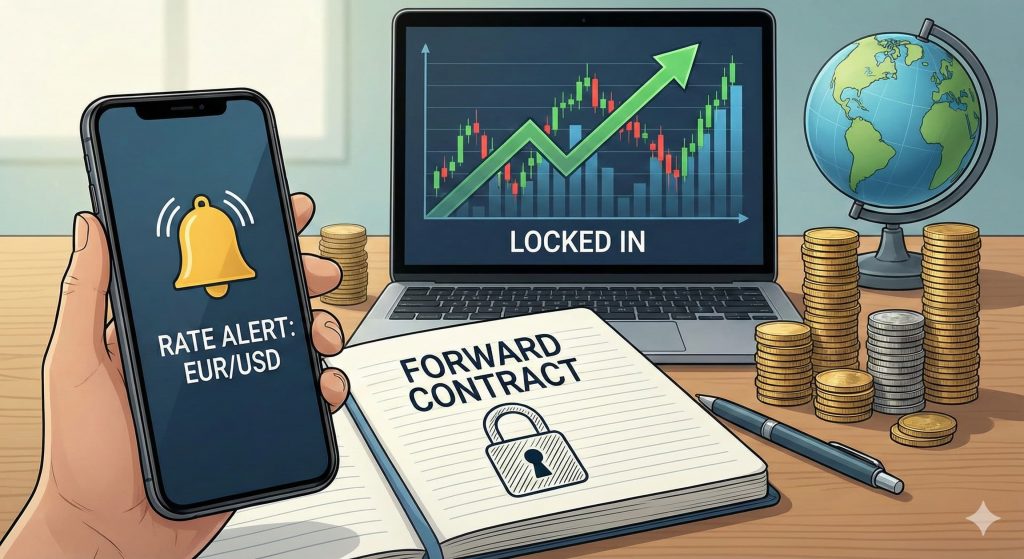
The good news is that you don’t have to accept whatever rate happens to be available on the day you need to exchange. Tools like rate alerts and forward contracts exist precisely to give individuals and businesses more control over when and at what rate their currency is converted. In this guide, we explain how these tools work, who they’re best suited for, and how to use them to protect the value of your money.
Why Exchange Rates Matter More Than Most People Realize
The True Cost of a Bad Rate
Most Canadians focus on fees when comparing currency exchange services — and rightly so. But the exchange rate itself is often a bigger cost than any visible fee. A difference of just 1% in the CAD/USD rate on a $50,000 transaction is $500. A 2% difference is $1,000. On a $200,000 real estate purchase, a 2% rate swing is $4,000 that either stays in your pocket or disappears quietly.
The table below illustrates how rate differences compound across common transaction sizes:
| Transaction Amount (CAD) | Impact of 1% Rate Difference | Impact of 2% Rate Difference | Impact of 3% Rate Difference |
|---|---|---|---|
| $5,000 | $50 | $100 | $150 |
| $25,000 | $250 | $500 | $750 |
| $50,000 | $500 | $1,000 | $1,500 |
| $100,000 | $1,000 | $2,000 | $3,000 |
| $250,000 | $2,500 | $5,000 | $7,500 |
When the stakes are this high, monitoring rates and using tools to lock them in becomes a practical financial decision — not an advanced technique reserved for currency traders.
Who Benefits Most from Rate Locking Tools
Rate alerts and forward contracts are useful for anyone making a significant currency exchange where the timing is flexible or the payment date is known in advance. The most common situations where these tools add clear value include:
- Cross-border real estate buyers and sellers: Property transactions involving USD and CAD routinely exceed $200,000 — even small rate improvements are worth thousands.
- Canadian snowbirds and retirees: Those converting large sums to USD for a season in the US or annual living expenses benefit from locking in before departure.
- Businesses paying international suppliers: Companies with recurring USD invoices or import costs can lock in rates weeks or months ahead of payment dates.
- Cross-border workers: Canadians earning USD and converting regularly to CAD benefit from tools that allow them to act when rates are favorable.
- Individuals sending large remittances: Timing larger transfers to coincide with favorable rates can meaningfully increase the amount received on the other end.
- Online sellers and freelancers: Those receiving regular USD income who want to convert strategically rather than at whatever rate exists on payout day.
Understanding Rate Alerts
What Is a Rate Alert?
A rate alert is a notification you set up in advance that triggers when a currency pair reaches a rate you specify. Instead of checking exchange rates manually every day — a time-consuming and easy-to-forget habit — you set your target rate once and receive an alert the moment the market hits it. You can then decide whether to act on it immediately or wait for conditions to develop further.
Rate alerts are one of the simplest and most practical tools available to individuals exchanging currency. They require no upfront commitment, no deposit, and no obligation to exchange. They simply keep you informed so you can act when the timing is right for you rather than discovering after the fact that rates moved in your favor while you weren’t watching.
How Rate Alerts Work in Practice
Setting a rate alert is straightforward. Here’s the general process:
- Step 1 — Identify your target rate: Check the current mid-market rate and decide what rate would represent a good outcome for your situation. This might be a rate that’s 1–2% better than today’s level, or a specific rate tied to a budget or break-even calculation.
- Step 2 — Register and set your alert: With a currency exchange service that offers rate monitoring, you register your target rate for a specified currency pair — for example, CAD/USD at 0.74 or better.
- Step 3 — Receive your notification: When the market reaches your target, you receive an alert by email, phone, or through the exchange platform.
- Step 4 — Decide and act: You then choose to lock in the rate immediately through a spot trade, or set a forward contract to secure the rate for a future payment date.
When Rate Alerts Are the Right Tool
Rate alerts work best when your exchange timing is flexible and you have a clear target rate in mind. They’re ideal for travelers who aren’t departing for several weeks, cross-border workers who can hold USD temporarily, or individuals awaiting the right moment to convert a lump sum. If you have a hard payment deadline — a property closing date, a supplier payment due date — a forward contract is the more appropriate tool, since rate alerts depend on the market reaching your target, which may not happen before your deadline.
Understanding Forward Contracts
What Is a Forward Contract?
A forward contract is an agreement to buy or sell a specified amount of currency at a rate agreed upon today, for delivery on a specific future date. It is the most widely used currency hedging tool available to individuals and businesses, and for good reason: it eliminates rate uncertainty entirely for a defined period of time.
When you enter a forward contract, the exchange rate is locked in regardless of what happens in the market between now and your delivery date. If the rate moves against you during that period, you’re protected — you still exchange at your agreed rate. If the rate moves in your favor, you forgo that benefit, but you also have the certainty of knowing exactly what your exchange will cost or yield, which for many transactions — especially large or time-sensitive ones — is worth more than the upside potential.
A Simple Forward Contract Example
Suppose you’re a Canadian business owner who needs to pay a US supplier $100,000 USD in 60 days. Today’s CAD/USD rate is 0.72, meaning you’d need approximately $138,888 CAD to cover the payment. But the rate could move by the time payment is due — in either direction.
Rather than guessing, you enter a forward contract today at 0.72 for $100,000 USD delivery in 60 days. In 60 days, you deliver $138,888 CAD and receive $100,000 USD at the agreed rate — no matter what the market did in between. If the rate dropped to 0.69 during that period, you saved yourself approximately $6,000 CAD by locking in early. If the rate rose to 0.75, you missed out on a slightly better deal — but you also avoided the risk that it could have fallen to 0.68 or lower.
Forward contracts are fundamentally about certainty, not speculation. They allow businesses and individuals to plan with confidence, protect margins, and eliminate the financial risk of rate volatility between now and a known future event.
Who Should Use a Forward Contract
Forward contracts are the right tool when:
- You have a known future payment or receipt in a foreign currency with a defined date
- The transaction amount is large enough that rate volatility represents a meaningful financial risk
- Your business needs cost certainty for budgeting, pricing, or margin protection purposes
- You’re buying or selling property cross-border and need to know your exact exchange cost at closing
- You’re satisfied with the current rate and want to eliminate the risk of it worsening before your transaction date
Market Orders: Another Tool for Rate-Conscious Exchangers
Target Orders
A target order — sometimes called a limit order — allows you to specify the exact rate at which you want to exchange currency. You set the amount you want to convert and a target rate better than today’s market level. Our market-monitoring traders watch conditions across all active sessions, and when the market reaches your specified rate, the order is executed automatically at that rate.
Target orders can be placed on an overnight basis or as “good-til-cancelled” orders, meaning they remain active until either executed or cancelled by you. This is particularly useful for clients who have a specific rate in mind and want to act on it without having to monitor the market themselves every day.
Trailing Stop Orders
A trailing stop order is a more dynamic tool designed to protect you from unfavorable rate movements while allowing you to benefit from continued improvement. You specify the amount of currency you want to exchange and the worst-case percentage change you’re willing to accept. If the market moves against you beyond that threshold, a spot or forward trade is executed automatically, capping your downside. If the market moves in your favor, the trailing stop moves with it — locking in gains without requiring you to monitor and manually adjust.
This tool is particularly valuable in volatile market conditions where rates are moving quickly in both directions, and you want a disciplined, automatic approach to protecting your outcome.
Combining Orders for Maximum Control
One of the most sophisticated approaches to rate management is placing a target order and a stop order simultaneously, with the instruction that if one is filled, the other is automatically cancelled. This eliminates the risk of double-booking and allows you to pursue a favorable rate while maintaining a defined floor below which you will not exchange. Our team at CanAm can walk you through setting up this kind of structured approach as part of a broader hedging strategy.
Rate Alerts vs. Forward Contracts vs. Market Orders: Which Is Right for You?
| Tool | Best For | Commitment Required | Rate Certainty |
|---|---|---|---|
| Rate Alert | Flexible timing, monitoring for a target rate | None — notification only | None until you act |
| Forward Contract | Known future payment date, cost certainty needed | Yes — obligated to exchange at maturity | Complete — rate locked in full |
| Target (Limit) Order | Automated execution at a specific target rate | Yes — executes if rate reached | High — rate specified in advance |
| Trailing Stop Order | Volatile markets, protecting against downside | Yes — executes at threshold | Partial — floor defined, upside open |
| Spot Trade | Immediate exchange at today’s rate | Yes — executes immediately | Complete — today’s rate |
The right tool depends on your situation, timeline, and risk tolerance. A traveler exchanging $3,000 for a European vacation in six weeks may benefit most from a rate alert combined with a spot trade when the alert triggers. A business paying $500,000 USD to a US partner in 90 days may be better served by a forward contract that eliminates all rate uncertainty from the planning process. Our team can help you identify which approach fits your specific circumstances.
Common Mistakes to Avoid When Managing Exchange Rates
Waiting for the “Perfect” Rate
One of the most common and costly mistakes is holding out indefinitely for an ideal rate that may never materialize. Markets can move against you just as easily as they can move in your favor, and delay always carries risk. Rate alerts help discipline this process by giving you a defined target, but once a good rate is achieved, acting on it promptly is almost always better than waiting for it to improve further.
Leaving Large Transactions Until the Last Minute
Urgency removes your negotiating position and your tool options. If you need to exchange $150,000 CAD by a real estate closing date that’s one week away, you have limited ability to wait for a better rate or set a meaningful forward contract. Planning ahead — by weeks or months for large transactions — gives you access to the full range of rate management tools and the time to use them effectively.
Not Accounting for Rate Volatility in Budgets
Businesses and individuals who budget cross-border transactions at today’s spot rate without hedging are implicitly accepting all the rate risk between now and their payment date. A forward contract removes this variable from your budget entirely — what you quoted is what you pay, regardless of what the market does. For businesses managing tight margins on international transactions, this predictability is often worth more than any potential upside from rate movements.
Take Control of Your Exchange Rate
Currency exchange doesn’t have to be passive. Whether you’re a traveler looking to secure a better rate before a trip, a business managing recurring international payments, or an individual facing a large cross-border transaction, tools like rate alerts, forward contracts, and market orders put you in control of when and at what rate your money is converted.
We offer the full suite of rate management tools — target orders, trailing stops, forward contracts, and good-til-cancelled market orders — supported by experienced traders who monitor markets across all active sessions on your behalf. Our rates already beat the major Canadian banks by up to 3%, and with the right tools in place, you can further optimize your outcome by acting when conditions suit you. Contact our team at 1-844-915-5151 or explore our business exchange and hedging services to learn more. You can also check our live USD to CAD rates to see today’s market before your next conversation with our team.