
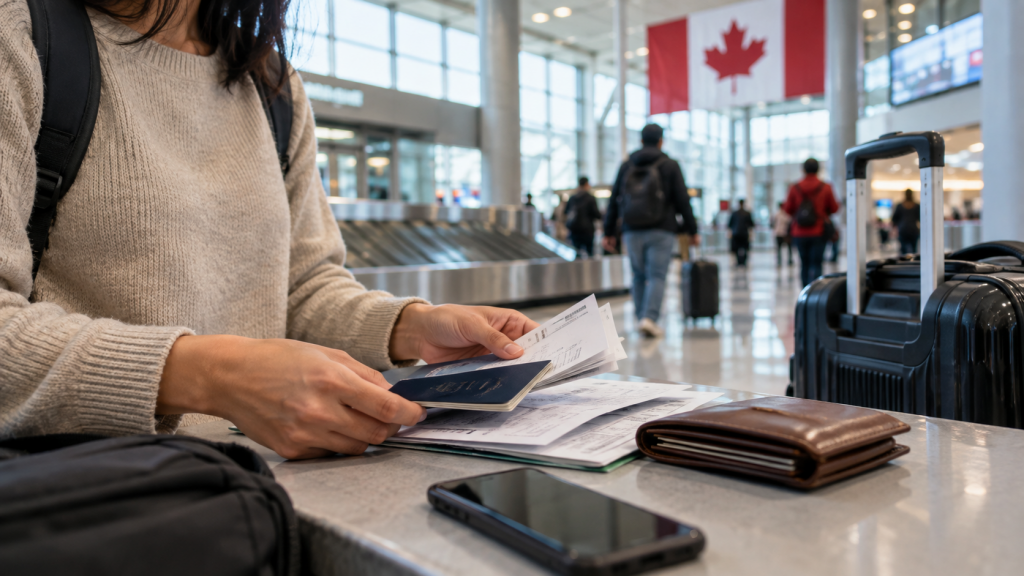
You can bring any amount of money into Canada. There is no limit. But if you bring in ten thousand Canadian dollars or more, you must declare it to the Canada Border Services Agency. That single rule causes most of the confusion, so this guide explains exactly how it works.
We help Canadians manage cross-border money every day, and understanding the declaration rule keeps your arrival smooth and compliant.
The Short Answer
There is no cap on how much money you can bring into or take out of Canada. However, amounts of ten thousand Canadian dollars or more, or the equivalent in foreign currency, must be reported to the Canada Border Services Agency on entry or exit.
Direct answer: You can bring any amount into Canada. If it is ten thousand Canadian dollars or more, you must declare it to CBSA. Not declaring can lead to seizure and penalties.
What Counts Toward the $10,000
The threshold covers more than just cash. It includes the combined value of:
- Cash in any currency
- Cheques, traveller’s cheques, and money orders
- Stocks, bonds, and other bearer instruments
- The Canadian-dollar equivalent of foreign currency you carry
If the combined total reaches ten thousand Canadian dollars or more, it must be declared, whether you are one traveller or a family travelling together whose combined total crosses the line.
How to Declare
Declaring is straightforward and free. It is not a tax, simply a report:
- Declare on your arrival form or verbally to a border officer
- Complete the CBSA cross-border currency reporting form if asked
- Keep the process honest and complete to avoid problems
Declaring does not cost you anything. The rule exists to help prevent money laundering, part of the same framework that regulates currency businesses through FINTRAC.
What Happens If You Do Not Declare
Failing to declare ten thousand Canadian dollars or more can have serious consequences. CBSA can seize the funds, and you may have to pay a penalty to recover them. In some cases the money may not be returned. Honesty is always the cheaper path.
Bringing Money Into Canada the Smart Way
If you are moving a large sum into Canada, carrying cash is rarely the best method anyway. An electronic transfer through a regulated provider is safer, traceable, and often cheaper on the exchange than converting cash. If you need to convert a foreign amount to Canadian dollars, a FINTRAC-regulated specialist prices close to the mid-market rate.
To convert a large sum securely rather than carry cash, you can register for free and request a quote, or see how it works first.
Leaving Canada With Money
The same rule applies in reverse. If you leave Canada carrying ten thousand Canadian dollars or more, or the foreign equivalent, you must declare it to CBSA on the way out. The reporting requirement is symmetrical, and the same consequences apply for failing to declare when exiting.
This matters for travellers, newcomers, and anyone relocating funds. If you are moving a large sum across the border in either direction, an electronic transfer is generally safer and simpler than carrying cash.
Newcomers Moving Funds to Canada
New residents often need to move significant savings into Canada. Carrying cash across the border is rarely the best method: it must be declared at ten thousand dollars or more, and it carries security risk. An electronic transfer through a regulated provider is traceable, safer, and lets you convert foreign currency to Canadian dollars at a competitive rate.
- Declare ten thousand Canadian dollars or more at the border
- Electronic transfers are safer and traceable for large sums
- Convert foreign savings at a rate close to mid-market, not a kiosk
How This Connects to Currency Rules
The declaration requirement is part of Canada’s broader anti-money-laundering framework, the same framework that requires currency exchange businesses to register with FINTRAC. Using a FINTRAC-regulated provider for large conversions keeps your transactions transparent and compliant, which is exactly what the border rules are designed to encourage.
Frequently Asked Questions
How much money can you bring into Canada?
There is no limit on how much money you can bring into Canada. However, ten thousand Canadian dollars or more, or the foreign equivalent, must be declared to the Canada Border Services Agency.
What happens if you do not declare money at the Canadian border?
If you fail to declare ten thousand Canadian dollars or more, CBSA can seize the funds and impose a penalty to recover them. In some cases the money may not be returned.
Does the $10,000 limit include foreign currency?
Yes. The threshold is based on the Canadian-dollar equivalent, so foreign currency counts. It also includes cheques, money orders, and other monetary instruments.
Is declaring money at the border a tax?
No. Declaring is a free report, not a tax. It exists to help prevent money laundering and does not cost you anything to complete.
What is the safest way to move a large sum into Canada?
An electronic transfer through a FINTRAC-regulated provider is safer and more traceable than carrying cash, and often cheaper on the exchange when converting foreign currency to Canadian dollars.
Move Large Sums Safely, Not in Cash
Convert and transfer through a FINTRAC-regulated specialist instead of carrying cash. Register for free for a quote, or call 1-844-915-5151.