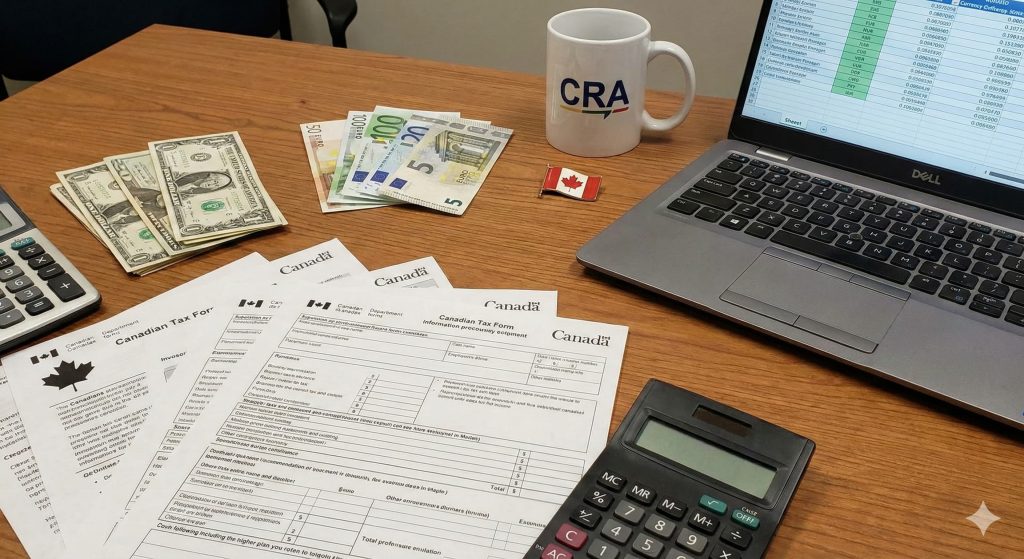
Canada Taxes Worldwide Income — Here’s What That Means
The CRA’s Residency-Based Tax System
Canada operates on a residency-based tax system. If you are a Canadian resident for tax purposes, you are required to report your worldwide income to the CRA — regardless of which country that income came from, which currency it was paid in, or whether it was already taxed in another country. This applies to employment income, self-employment income, rental income, investment income, pension payments, and more.
This catches many Canadians off guard, particularly those who work for US employers, receive foreign rental income, hold foreign investments, or have recently moved to Canada. The fact that you paid tax on income in another country does not automatically exempt you from reporting it in Canada. However, Canada has tax treaties with many countries — including the United States — that prevent you from paying full tax twice on the same income through foreign tax credits.
What Must Be Reported
Common types of foreign income that Canadian tax residents must report include:
- Foreign employment income: Wages, salaries, or contract payments received from a non-Canadian employer, including US companies paying in USD
- Foreign business income: Revenue earned by self-employed Canadians from foreign clients, freelance work, or online businesses paid in foreign currency
- Foreign investment income: Dividends, interest, and capital gains from foreign stocks, ETFs, bonds, or savings accounts held outside Canada
- Foreign rental income: Rent received from properties owned in the US or any other country
- Foreign pension income: Pension or retirement payments received from foreign plans or government programs
- Proceeds from selling foreign assets: Capital gains from selling US real estate, foreign stocks, or other assets denominated in foreign currency
All of the above must be converted to Canadian dollars before being reported on your T1 General tax return. The exchange rate you use matters — and the CRA has specific rules about which rates are acceptable.
How to Convert Foreign Income to CAD for the CRA
The Two Accepted CRA Exchange Rate Methods
When reporting foreign income in Canadian dollars, the CRA accepts two methods for determining which exchange rate to use. Both are based on Bank of Canada rates, which are publicly available at bankofcanada.ca.
| Method | How It Works | Best For | Record-Keeping Requirement |
|---|---|---|---|
| Daily Rate Method | Use the Bank of Canada’s published rate on the specific date each payment was received | Higher accuracy; preferred when rates fluctuated significantly during the year | High — requires tracking the date and rate for every individual payment |
| Annual Average Rate Method | Use the Bank of Canada’s average annual exchange rate for all income received during the year | Simplicity; works well for regular income received evenly throughout the year | Low — one rate applies to all income for the full year |
For most Canadians with regular foreign employment income — such as cross-border workers receiving consistent USD paycheques — the annual average rate method is simpler and produces a reasonable result. For those with large lump-sum receipts (a property sale, inheritance, or major investment payout), the daily rate method may produce a more accurate and potentially more favorable result depending on when in the year the transaction occurred.
One important note: you cannot mix methods freely on the same return for the same income type. Choose the method that best fits your situation and apply it consistently. A qualified tax accountant can help you determine which approach is most advantageous for your specific circumstances.
Where to Find Bank of Canada Exchange Rates
The Bank of Canada publishes daily and average annual exchange rates on its website (bankofcanada.ca). Rates are available for major currencies including USD, EUR, GBP, JPY, AUD, and many others. For the annual average rate, the Bank of Canada publishes a specific table each year that you can use directly on your tax return. The CRA also publishes its own version of acceptable annual average rates for commonly used currencies on its website (canada.ca/cra).
Do You Need to Declare Currency Exchange Transactions Themselves?
Personal Currency Exchange for Travel
For most Canadians, exchanging currency for personal travel is not a taxable event and does not need to be reported to the CRA. If you convert $3,000 CAD into euros before a European vacation and convert leftover euros back to CAD when you return, there is no tax reporting requirement for that transaction. The currency exchange itself does not generate income or a capital gain in any meaningful sense for ordinary travel purposes.
Large Currency Transactions and FINTRAC Reporting
Canada’s financial intelligence rules, administered through FINTRAC (the Financial Transactions and Reports Analysis Centre of Canada), require regulated financial entities — including banks and licensed currency exchange services — to report certain large or suspicious transactions. This is a reporting obligation on the service provider, not a tax declaration obligation on the individual.
Specifically, currency exchange businesses and banks are required to report cash transactions of $10,000 or more to FINTRAC. This is an anti-money-laundering compliance measure, not a tax trigger. The fact that a transaction is reported to FINTRAC does not mean you owe additional tax — it simply means the transaction is on record with Canada’s financial intelligence unit. For regulated services like CanAm, FINTRAC reporting is part of standard compliance operations (MSB registration M15487609).
When Currency Exchange Can Create a Taxable Event
While routine travel exchange is not taxable, there are situations where holding or exchanging foreign currency can have tax implications:
- Foreign currency held as an investment: If you deliberately hold USD or another currency as a speculative investment and later sell it at a gain, the CRA may treat that gain as a capital gain subject to tax reporting.
- Business foreign currency transactions: Businesses that hold foreign currency balances may have unrealized or realized foreign exchange gains or losses that affect their taxable income. These must be reported on the business tax return.
- Conversion gains on foreign debt: If you borrowed in a foreign currency and repaid it at a more favorable rate, the gain on that conversion may be taxable.
- Foreign property over $100,000 CAD: Canadians who own specified foreign property with a total cost exceeding $100,000 CAD must file Form T1135 (Foreign Income Verification Statement). This includes foreign bank accounts, foreign stocks, and foreign real estate held for investment (but not personal-use property).
Common Currency-Related Tax Situations for Canadians
Cross-Border Workers Earning USD
Canadians who live in Canada and work for a US employer — whether commuting across the border or working remotely — must report their USD income on their Canadian tax return in CAD. They may also be required to file a US tax return depending on their work situation. The Canada-US Tax Treaty prevents double taxation: any US taxes withheld from your income can generally be claimed as a foreign tax credit on your Canadian return using Form T2209, reducing your Canadian tax payable.
Key steps for cross-border workers at tax time:
- Convert all USD income to CAD using either the daily or annual average Bank of Canada rate
- Gather all US tax documents (W-2 for employees, 1099 for contractors) as your Canadian accountant will need them
- Calculate and claim your foreign tax credit (Form T2209) for any US taxes already withheld
- Track exchange rates used for conversion so your methodology is documentable if the CRA ever requests it
- Consider whether you need to file a US return — this depends on your residency status, how much time you spent in the US, and your income level
Canadians Receiving Foreign Investment Income
Foreign dividends, interest, and capital gains are taxable in Canada when received by Canadian residents, and all amounts must be reported in CAD. Foreign dividends are generally reported as foreign income (not eligible for the Canadian dividend tax credit). Withholding taxes paid to foreign governments can typically be claimed as foreign tax credits, though the rules vary by country and income type.
If you hold US stocks or ETFs in a non-registered account, any dividends received are subject to a 15% US withholding tax under the Canada-US Tax Treaty — this can be claimed as a foreign tax credit on your Canadian return. US dividends held in an RRSP are generally exempt from US withholding tax under the treaty, which is one of the tax efficiency advantages of holding US investments in a registered account.
Canadians Who Sold Foreign Real Estate
If you sold a property in the US or another country during the tax year, the capital gain (or loss) must be reported on your Canadian return. The gain is calculated in Canadian dollars: the difference between the sale proceeds converted to CAD at the rate on the sale date, and your adjusted cost base in CAD (the original purchase price and any improvements, converted at the rate when those amounts were paid).
This calculation can be complex because exchange rate fluctuations over the years you owned the property affect the CAD-denominated gain independently of what the property value did in local currency. A tax professional with cross-border real estate experience is strongly recommended for these situations.
T1135 — Foreign Income Verification Statement
Canadians with specified foreign property totalling more than $100,000 CAD at any point during the year must file Form T1135 with their tax return. This form requires detailed disclosure of foreign accounts, investments, and real estate held for investment. The penalties for failing to file T1135 when required are substantial — up to $25 per day for late filing, and potentially much larger penalties for repeated failures or deliberate non-compliance.
Assets that count toward the $100,000 threshold include:
- Foreign bank accounts and cash holdings
- Shares in foreign corporations held outside a Canadian registered account
- Foreign bonds, debentures, and notes
- Foreign rental properties
- Interests in foreign trusts or partnerships
Assets that do NOT count include foreign property used for personal use (a vacation home you use personally), shares in Canadian corporations even if those corporations hold foreign assets, and foreign assets held inside a registered account (RRSP, TFSA, RRIF).
Record-Keeping: The Foundation of a Clean Tax Filing
What to Track Throughout the Year
The single best thing you can do to simplify currency-related tax reporting is keep organized records throughout the year rather than scrambling at tax time. For Canadians with any foreign financial activity, a simple tracking system should capture:
- Date of each foreign income receipt or payment
- Amount in foreign currency and the CAD equivalent at the applicable rate
- Exchange rate used and the source (Bank of Canada daily or annual average)
- Any foreign taxes withheld from income
- Currency exchange receipts and trade confirmations for large transactions
- Foreign bank statements and investment account statements
Every currency exchange transaction completed through CanAm comes with a written trade confirmation detailing the rate, amount, and date — providing exactly the kind of documentation a CRA-compliant record-keeping system needs. Keeping these confirmations on file means you have a clear, traceable record of every conversion if your return is ever reviewed.
How Long to Keep Records
The CRA generally requires taxpayers to keep records for six years from the end of the tax year to which they relate. For capital assets like foreign property, records should be kept for six years after the year the property was sold — which could mean keeping purchase records for decades on a long-held asset. Digital filing and cloud backup make this straightforward and eliminates the risk of lost paperwork.
A Note on Currency Exchange Costs and Your Tax Return
Currency exchange fees and rate markups paid to a bank are generally not deductible for personal income tax purposes. However, for businesses, the cost of currency exchange as part of legitimate business operations may be deductible as a business expense. If you are self-employed and converting USD client payments to CAD, the difference between the mid-market rate and the rate you received (i.e., the exchange cost) could potentially be treated as a business cost — speak with your accountant about whether this applies to your situation.
This is one more reason to use a competitive currency exchange service rather than a bank for business-related conversions. Our rates beat the major banks by up to 3% with no transaction fees, meaning less of your revenue is absorbed by exchange costs regardless of how those costs are treated on your return. For guidance on how we support cross-border workers and businesses with efficient currency conversion, explore our cross-border workers currency exchange guide or check our live USD to CAD rates to see what your next conversion would yield.
This article is for general informational purposes only and does not constitute tax or legal advice. Tax rules are complex and change over time. Canadians with foreign income, foreign assets, or cross-border financial activity should consult a qualified Canadian tax professional for guidance specific to their situation.