
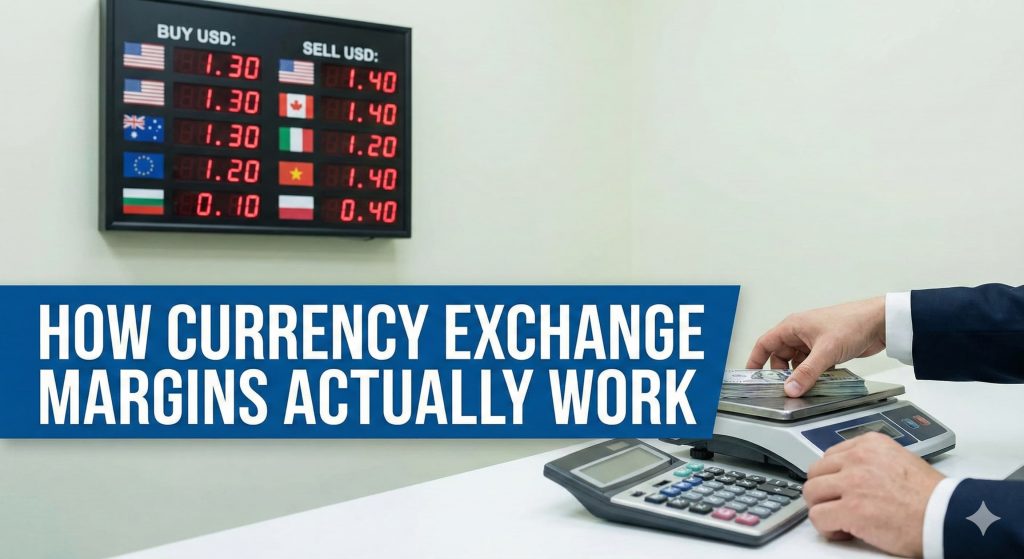
When you exchange currency, the rate you receive is never quite the same as the rate you see on Google or in the financial news. That difference—often invisible and rarely explained—is the exchange margin. Understanding how margins work helps you recognize whether you’re getting a fair deal and how much your currency exchange is actually costing you.
This guide explains the mechanics behind currency exchange pricing, why margins exist, and how to evaluate whether the rate you’re being offered represents good value.
The Foundation: What Is the Mid-Market Rate?
Every currency pair has what’s called a mid-market rate (also known as the interbank rate). This is the rate at which large financial institutions trade currencies with each other—essentially the wholesale price of currency. When you search “CAD to USD” on Google or check a site like XE.com, you’re seeing the mid-market rate.
The mid-market rate represents the fair value of one currency relative to another at any given moment. It’s calculated as the midpoint between the buying price (bid) and selling price (ask) in the global foreign exchange market. This rate fluctuates constantly based on supply and demand, economic conditions, interest rates, political events, and countless other factors.
Here’s the key point: you will almost never receive the mid-market rate when exchanging currency. Instead, you’ll receive a retail rate that includes a margin—and that margin is how currency exchange providers make money.
The Bid-Ask Spread: Where Margins Begin
To understand exchange margins, you first need to understand how currency markets work. At any moment, there are two prices for every currency pair:
- The bid price: The price at which a dealer will buy currency from you
- The ask price: The price at which a dealer will sell currency to you
The ask price is always higher than the bid price. This difference is called the bid-ask spread, and it exists because dealers need to cover their costs and earn a profit. Think of it like a used car dealer who buys vehicles at one price and sells them at a higher price—the difference is their operating margin.
A Simple Example
Let’s say the mid-market rate for CAD/USD is 0.7350 (meaning 1 Canadian dollar equals 0.7350 US dollars). A currency provider might set their rates as follows:
| Transaction Type | What You’re Doing | Rate Offered | Margin from Mid-Market |
|---|---|---|---|
| Selling CAD, buying USD | Converting CAD to USD | 0.7200 | 2.04% below mid-market |
| Selling USD, buying CAD | Converting USD to CAD | 0.7500 | 2.04% above mid-market |
In this example, the total spread is about 4%, split between buying and selling. The provider profits on every transaction regardless of which direction the exchange goes.
How Exchange Margins Are Expressed
Currency exchange margins can be expressed in different ways, which sometimes makes comparison difficult:
Percentage Markup
The most straightforward way to express a margin is as a percentage above or below the mid-market rate. If the mid-market rate is 0.7350 and you’re offered 0.7200, the margin is approximately 2%. This is the easiest method for comparing providers.
Pips or Points
In professional forex trading, spreads are measured in “pips” (percentage in point)—the smallest standard price movement. For most currency pairs, one pip equals 0.0001. A spread of 50 pips on CAD/USD would be 0.0050, which on a mid-market rate of 0.7350 represents about 0.68%.
Cents Per Dollar
Some providers, particularly those serving retail customers, express their margin in cents. A provider offering “1.5 cents off the rate” on USD exchanges is charging 1.5% on each dollar exchanged.
Why Margins Vary So Much Between Providers
Exchange margins can range from nearly zero (for large institutional trades) to 10% or more (at poorly-priced retail locations). Several factors explain this wide variation:
Operating Costs
Different providers have different cost structures. An airport kiosk with expensive real estate, 18-hour staffing, and small average transaction sizes needs wider margins to stay profitable than an online provider processing high volumes with minimal overhead.
Transaction Size
Larger exchanges typically receive better rates because the fixed costs of processing a transaction are spread across more dollars. Exchanging $10,000 costs a provider almost the same to process as exchanging $500, so they can offer tighter margins on bigger amounts.
Currency Pair Liquidity
Major currency pairs like CAD/USD or EUR/USD have enormous trading volumes, making them highly liquid. Providers can offer tighter margins because they can easily buy and sell these currencies in the wholesale market. Exotic currencies with lower trading volumes carry more risk and cost more to source, resulting in wider margins.
Competition and Market Position
Providers in competitive markets tend to offer better rates. Banks, with their captive customer bases and high brand trust, often charge wider margins than specialized currency exchange services that compete primarily on price.
Regulatory and Compliance Costs
Licensed, regulated providers incur costs for compliance, auditing, and maintaining proper controls. While these costs get built into margins, they also provide customer protection that unlicensed operators can’t offer.
The Real Cost: Calculating What You’re Paying
Understanding how to calculate the actual cost of your currency exchange helps you compare providers accurately. Here’s the formula:
Margin % = ((Mid-Market Rate – Your Rate) / Mid-Market Rate) × 100
Worked Example
You want to convert $2,000 CAD to USD. The mid-market rate is 0.7350 CAD/USD.
Provider A offers: 0.7200
- Margin: (0.7350 – 0.7200) / 0.7350 = 2.04%
- You receive: $2,000 × 0.7200 = $1,440 USD
- At mid-market you’d get: $2,000 × 0.7350 = $1,470 USD
- Cost of margin: $30 USD
Provider B offers: 0.7280
- Margin: (0.7350 – 0.7280) / 0.7350 = 0.95%
- You receive: $2,000 × 0.7280 = $1,456 USD
- Cost of margin: $14 USD
Provider B saves you $16 on this single transaction—a meaningful difference that compounds on larger or repeated exchanges.
Typical Margins by Provider Type
While individual providers vary, here are typical margin ranges you can expect from different types of currency exchange services:
| Provider Type | Typical Margin Range | Cost on $1,000 Exchange |
|---|---|---|
| Airport kiosks | 5% – 10% | $50 – $100 |
| Hotel exchange desks | 5% – 8% | $50 – $80 |
| Major banks | 2.5% – 4% | $25 – $40 |
| Credit unions | 2% – 3.5% | $20 – $35 |
| Specialized currency exchange | 1% – 2% | $10 – $20 |
| Online currency specialists | 0.5% – 1.5% | $5 – $15 |
These figures are approximate and vary by currency pair, transaction size, and specific provider. The key insight is that convenience often comes with a significant cost premium.
Hidden Margins: When “No Fee” Isn’t Free
Many providers advertise “no fees” or “zero commission” on currency exchange. While technically true, this can be misleading. Instead of charging an explicit fee, these providers simply widen their exchange margin. You’re still paying—it’s just hidden in the rate rather than listed as a separate charge.
How to Spot Hidden Margins
When evaluating a “no fee” offer, always check the exchange rate being offered against the current mid-market rate. A provider advertising no fees but offering a rate 4% off mid-market is effectively charging you a 4% fee—they’ve just embedded it in the exchange rate.
Some providers are transparent about this practice; others are not. The most trustworthy providers clearly state both their exchange rate and how it compares to the mid-market rate, allowing you to see exactly what you’re paying for the service.
Margin vs. Fee: Understanding Total Cost
Some providers charge both a margin on the exchange rate and a separate transaction fee. Others charge only a margin with no additional fee. To compare providers accurately, you need to calculate the total cost including both components.
Example Comparison
Provider A: 1.5% margin, $10 transaction fee
Provider B: 2.5% margin, no transaction fee
On a $500 exchange:
- Provider A: $7.50 (margin) + $10 (fee) = $17.50 total cost
- Provider B: $12.50 (margin) + $0 (fee) = $12.50 total cost
On a $2,000 exchange:
- Provider A: $30 (margin) + $10 (fee) = $40 total cost
- Provider B: $50 (margin) + $0 (fee) = $50 total cost
Provider B is cheaper for small amounts, while Provider A becomes more economical for larger exchanges. The crossover point in this example is around $1,000.
What Affects the Margin You’re Offered?
Several factors influence the specific margin a provider will charge you:
Currency Pair
Major currencies (USD, EUR, GBP, JPY) have tighter margins than exotic currencies. Converting CAD to Thai baht will typically cost more in margin than converting CAD to USD because the market for baht is smaller and sourcing it requires more steps.
Transaction Size
Most providers offer better rates for larger exchanges. If you’re exchanging $5,000 or more, ask about preferred rates—many providers have unpublished tiers for larger transactions.
Customer Relationship
Regular customers or those with business accounts often receive better rates than one-time retail customers. Building a relationship with a currency provider can reduce your long-term costs.
Market Volatility
During periods of high market volatility—major elections, economic crises, or significant news events—providers widen their margins to protect against rapid rate movements. If you can time your exchange during calmer market periods, you may receive better rates.
Time of Day
Currency markets are most liquid during overlapping trading hours between major financial centers. For CAD/USD, this typically means better rates during North American business hours when both Canadian and US markets are active.
How to Evaluate If You’re Getting a Fair Rate
Follow these steps to determine whether a quoted rate represents good value:
Step 1: Check the Current Mid-Market Rate
Look up the live mid-market rate on Google, XE.com, or the Bank of Canada website. Note the exact time you check, as rates change throughout the day.
Step 2: Calculate the Margin Being Charged
Use the formula: Margin % = ((Mid-Market Rate – Offered Rate) / Mid-Market Rate) × 100
Step 3: Add Any Explicit Fees
If the provider charges a transaction fee, add this to your margin cost to get the total cost.
Step 4: Compare Across Providers
Check rates from at least two or three providers. The spread between the best and worst options can easily be 3-5%, which on a $2,000 exchange represents $60-$100 in savings.
Step 5: Consider Non-Price Factors
The cheapest rate isn’t always the best choice. Consider factors like convenience, transaction speed, security, and customer service. A slightly higher margin from a reputable, regulated provider may be worth paying for peace of mind.
Margins on Different Types of Transactions
Exchange margins can vary depending on how you’re accessing the currency:
Cash Exchange
Physical currency typically carries the widest margins because it requires inventory management, security, and handling costs. Providers need to maintain cash reserves in multiple currencies and bear the risk of currency fluctuations on their holdings.
Wire Transfers
International wire transfers often have tighter margins than cash exchange because no physical currency changes hands. However, wire transfers may include additional fees from intermediary banks, so the total cost requires careful calculation.
Credit/Debit Card Transactions
When you use a card abroad, your bank applies a margin to the conversion (typically 2.5% for most Canadian cards) plus potentially a foreign transaction fee. Some premium travel cards offer better rates or waive foreign transaction fees entirely.
ATM Withdrawals Abroad
Foreign ATM withdrawals combine multiple costs: your bank’s exchange margin (typically 2.5%), an international ATM fee ($3-$5), and potentially a fee from the ATM operator. The effective margin on small withdrawals can be quite high.
Why Margins Exist: The Provider’s Perspective
Understanding why providers charge margins helps contextualize what you’re paying for:
Market Risk
When a provider commits to an exchange rate, they take on risk that the market will move against them before they can complete their side of the transaction. Margins compensate for this risk.
Operational Costs
Running a currency exchange business involves significant costs: licensing and regulation, staff, technology, security, real estate, and insurance. Margins fund these essential operations.
Inventory Costs
Maintaining ready access to multiple currencies requires capital. Providers must keep cash reserves or credit facilities to fulfill customer requests, and this capital has a cost.
Profit
Like any business, currency exchange providers need to generate profit to survive and grow. A reasonable margin allows for sustainable business operations while providing customers with a valuable service.
When Narrow Margins Aren’t Always Better
While lower margins generally benefit customers, extremely narrow margins can sometimes signal concerns:
Unsustainable Business Models
Providers offering rates too close to mid-market may be operating unsustainably, potentially creating risk if the business fails while holding your funds.
Hidden Costs Elsewhere
Some providers offer attractive exchange rates but impose costs elsewhere: slow transfer times, poor customer service, or restrictive terms and conditions.
Regulatory Concerns
Unregulated providers may offer better rates because they don’t bear compliance costs—but they also don’t offer the protections that regulation provides.
A reputable provider with reasonable margins, proper licensing, and strong customer service often delivers better overall value than the absolute cheapest rate from an unknown source.
The Bottom Line: Being an Informed Customer
Currency exchange margins are a legitimate business practice, not a scam. Providers need margins to cover costs and remain in business. Your goal as a customer isn’t to eliminate margins—it’s to ensure you’re paying a fair margin for good service.
Armed with understanding of how margins work, you can:
- Compare providers based on actual total cost, not marketing claims
- Recognize when “no fee” offers are genuinely good value versus marketing spin
- Negotiate better rates on larger transactions
- Time your exchanges to potentially capture better market conditions
- Make informed decisions that balance cost with other important factors
Get Transparent, Competitive Rates
At CanAm Currency Exchange, we believe in transparent pricing. Our rates are consistently better than Canadian banks, and we’re always happy to explain exactly what you’re paying and why. We don’t hide our margins behind “no fee” marketing—we simply offer competitive rates that deliver real value.
- Clear, competitive exchange rates for major currency pairs
- No hidden fees embedded in misleading pricing
- FINTRAC regulated for your security and peace of mind
- Personal service from real currency specialists
Have questions about our rates or how currency exchange pricing works? We’re happy to help.
Call us at +1 (844) 915-5151 or visit our website to get a quote.
Frequently Asked Questions
What is a reasonable exchange margin?
For major currencies like USD/CAD, a margin of 1% to 2% from a retail provider represents fair value. Banks typically charge 2.5% to 4%, while airport kiosks can charge 5% to 10% or more. The right margin depends on your priorities—convenience, transaction size, and service quality all factor into value.
Why is the airport exchange rate so bad?
Airport kiosks face high real estate costs, extended operating hours, smaller average transaction sizes, and a captive customer base that often needs currency urgently. These factors combine to require wider margins—often 5% to 10%—to maintain profitability.
How do I check if I’m getting a fair exchange rate?
Look up the current mid-market rate on Google or XE.com, then calculate the percentage difference between that rate and the rate you’re being offered. For major currencies, anything under 2% from a retail provider is competitive; over 3% warrants shopping around.
Why do banks charge higher margins than currency exchange specialists?
Banks have higher overhead costs, serve captive customer bases less likely to shop around, and often treat currency exchange as a secondary service rather than a core competency. Specialized currency providers compete primarily on exchange rates, driving them to offer tighter margins.
Does the margin change based on how much I’m exchanging?
Yes, most providers offer better rates for larger transactions. The fixed costs of processing an exchange are spread over more dollars, allowing tighter margins. If you’re exchanging $5,000 or more, always ask about preferred rates.
What’s the difference between margin and spread?
These terms are often used interchangeably but have slightly different technical meanings. The spread is the difference between bid and ask prices in the wholesale market. The margin is the markup a retail provider adds above (or below) the mid-market rate when quoting customers. In practice, both describe the cost built into your exchange rate.
Can I negotiate exchange rates?
For larger transactions, yes. Many providers have flexibility on rates for exchanges over certain thresholds (often $5,000-$10,000). Business customers or those making regular exchanges may also qualify for preferred pricing. It never hurts to ask.
Why do margins vary between currency pairs?
Major currencies like USD, EUR, and GBP have enormous trading volumes, creating highly liquid markets where providers can operate with tighter margins. Less common currencies have smaller markets, more price volatility, and higher sourcing costs—all of which result in wider margins.
Is a “no fee” exchange actually free?
No. When a provider advertises “no fee” or “zero commission,” they’re building their profit into the exchange rate margin instead of charging a separate fee. To evaluate the true cost, compare their offered rate to the mid-market rate—the difference is your effective fee.
How often do exchange margins change?
Exchange rates change constantly throughout the trading day, but the margin a provider charges tends to remain relatively stable over time. Margins may widen during periods of high market volatility or for currencies experiencing unusual market conditions.