
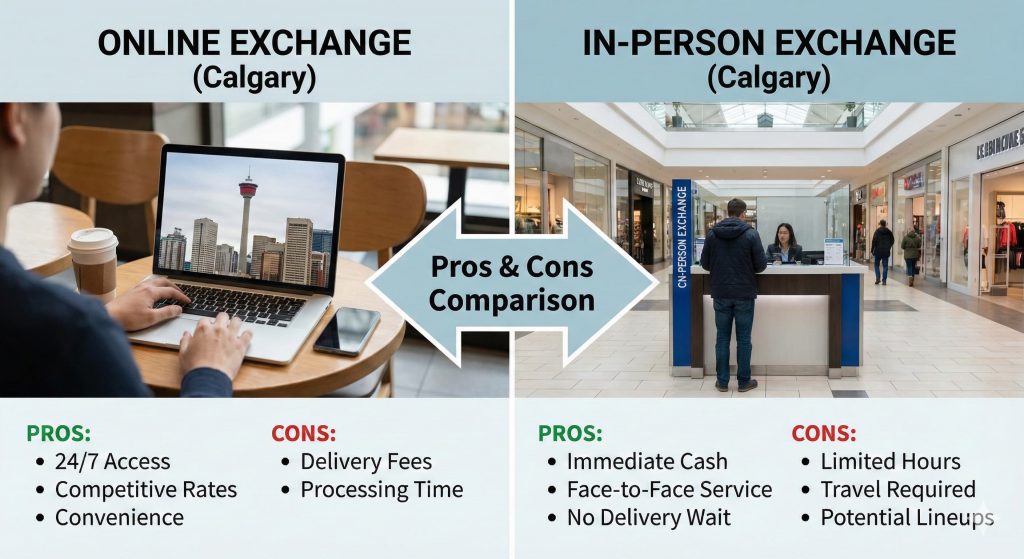
Calgary residents have more currency exchange options than ever before. Whether you’re preparing for a vacation, managing business payments, or sending money to family abroad, you can choose between visiting a physical location or completing your exchange entirely online. Each approach has distinct advantages and trade-offs worth considering.
This guide breaks down the pros and cons of both methods to help you make the best choice for your specific situation—and your wallet.
Understanding Your Currency Exchange Options in Calgary
Before diving into the comparison, let’s clarify what each option actually involves. Understanding the mechanics helps you evaluate which approach fits your needs.
In-Person Currency Exchange
In-person exchange means visiting a physical location to convert your money. In Calgary, your in-person options include:
- Banks: TD, RBC, BMO, CIBC, and Scotiabank branches throughout the city
- Downtown exchange bureaux: Specialized currency shops in the CORE Shopping Centre and surrounding area
- Neighbourhood exchange shops: Locations in areas like northeast Calgary near the airport corridor
- Airport kiosks: ICE (International Currency Exchange) and other providers at YYC Calgary International Airport
- Shopping mall locations: Exchange counters at Market Mall, Chinook Centre, and other retail centres
Online Currency Exchange
Online exchange involves using a digital platform to convert currency. The funds are typically transferred electronically to your bank account, or in some cases, physical currency can be delivered to your home. Online providers include specialized currency exchange companies, some traditional banks’ digital platforms, and fintech services.
In-Person Currency Exchange: The Pros
Walking into a physical location offers several genuine advantages that matter to certain customers and situations.
Immediate Access to Cash
The most significant benefit of in-person exchange is instant availability. You walk in with Canadian dollars and walk out with foreign currency in hand—no waiting for transfers or deliveries. For travelers departing within hours or anyone who simply wants cash immediately, this matters tremendously.
Downtown Calgary bureaux and mall locations typically stock major currencies like USD, EUR, GBP, and MXN for immediate exchange. Less common currencies may require advance ordering even at physical locations, but popular travel currencies are usually available on the spot.
Face-to-Face Service
Some people prefer conducting financial transactions in person. You can ask questions directly, verify counts together, and have a human being handle your money. For those uncomfortable with digital financial services—or simply those who value personal interaction—this provides peace of mind.
Physical locations also allow you to inspect the currency before accepting it. You can confirm the bills are in good condition, which matters since some countries and merchants are particular about accepting worn or marked notes.
No Technology Required
In-person exchange requires nothing more than showing up with your money and identification. You don’t need a smartphone, computer, bank account configured for online transfers, or comfort with digital platforms. This accessibility matters for customers who aren’t technologically inclined or prefer keeping financial matters offline.
Ability to Negotiate on Large Amounts
When exchanging substantial sums—typically $5,000 or more—some physical locations will negotiate rates. Speaking directly with a manager or experienced staff member can sometimes yield better pricing than the posted rate. This negotiation opportunity doesn’t exist with most automated online platforms.
In-Person Currency Exchange: The Cons
Despite these advantages, physical currency exchange comes with notable drawbacks that cost Calgary residents real money.
Significantly Higher Costs
This is the elephant in the room. In-person currency exchange almost always costs more than online alternatives, sometimes dramatically so. Here’s how rates typically compare:
| Exchange Method | Typical Markup Above Mid-Market Rate | Cost on $2,000 CAD Exchange |
|---|---|---|
| YYC Airport kiosks | 5% – 8% | $100 – $160 |
| Calgary banks | 2.5% – 3.5% | $50 – $70 |
| Downtown exchange bureaux | 2% – 4% | $40 – $80 |
| Online currency specialists | 1% – 1.5% | $20 – $30 |
On a typical vacation exchange of $2,000 CAD, choosing airport exchange over online could cost you an extra $80 to $130—money that could fund a nice dinner, attraction tickets, or simply stay in your bank account.
Limited Hours and Location Constraints
Physical locations operate on fixed schedules. Downtown Calgary bureaux typically open around 9:00 AM and close by 6:00 PM on weekdays, with reduced weekend hours. If you work standard business hours, finding time to visit during operating hours can be challenging.
You also need to factor in travel time. Driving downtown from the suburbs, finding parking, and waiting in line can easily consume 45 minutes to an hour—time that has real value, especially during busy pre-travel preparation periods.
Currency Availability Issues
Not every location stocks every currency. If you need Thai baht, South African rand, or other less common currencies, many Calgary locations will require you to place an advance order and return later for pickup. This eliminates the “immediate access” advantage while still subjecting you to higher in-person rates.
Even for common currencies, physical locations can occasionally run low on inventory during peak travel seasons. Arriving to find a location temporarily out of US dollars is frustrating when you’re departing the next morning.
Security Considerations
Carrying large amounts of cash to and from exchange locations creates security risks. Walking through downtown Calgary or a parking lot with thousands of dollars in foreign currency isn’t ideal, particularly if you’re visibly carrying an envelope or currency sleeve.
Online Currency Exchange: The Pros
Digital currency exchange has grown rapidly because it addresses many frustrations with traditional methods while offering compelling benefits.
Substantially Better Exchange Rates
The math is straightforward: online currency specialists typically offer rates 1% to 2.5% better than banks and 4% to 7% better than airport kiosks. These savings compound on larger exchanges.
Online providers achieve better rates because they operate with lower overhead—no expensive retail locations, fewer staff, and automated processes. They pass these savings to customers through more competitive pricing. For a Calgary business owner exchanging $10,000 monthly for US supplier payments, the difference between bank rates and online rates could exceed $2,500 annually.
24/7 Availability
Online platforms never close. You can initiate an exchange at 11 PM on a Sunday, during your lunch break, or whenever fits your schedule. This flexibility is particularly valuable for busy professionals who can’t easily visit physical locations during business hours.
Rate monitoring also becomes easier online. Many platforms offer rate alerts that notify you when exchange rates reach your target level, allowing you to lock in favorable rates rather than accepting whatever rate happens to exist when you finally have time to visit a branch.
Convenience and Time Savings
Completing a currency exchange online takes 10 to 15 minutes for first-time users and just a few minutes for subsequent transactions. Compare this to driving downtown, parking, waiting in line, completing the transaction, and returning home—easily an hour or more of your day.
For Calgarians in communities like Airdrie, Cochrane, Okotoks, or Chestermere, the time savings are even more significant. Rather than driving 30+ minutes each way to reach a downtown exchange location, you can complete the entire transaction from your kitchen table.
Better Record Keeping
Online transactions automatically generate digital records—confirmation emails, transaction histories, and receipts accessible anytime through your account. This documentation simplifies expense tracking for business travelers, tax preparation, and general financial organization.
Physical transactions typically produce only paper receipts that are easily lost or damaged. Reconstructing your exchange history from in-person transactions months later can be nearly impossible.
Access to More Currencies
Online platforms frequently offer broader currency selections than physical locations can maintain in inventory. If you need less common currencies for travel to emerging destinations, online providers are more likely to accommodate your needs without special ordering delays.
Enhanced Security
Reputable online currency exchange providers are regulated by FINTRAC (Financial Transactions and Reports Analysis Centre of Canada) and maintain bank-level security protocols. Your funds transfer electronically between regulated financial institutions, eliminating the risks associated with physically transporting cash.
Client funds are typically held in segregated accounts at major Canadian banks, providing protection similar to traditional banking relationships.
Online Currency Exchange: The Cons
Online exchange isn’t perfect for every situation. Understanding the limitations helps you decide when in-person alternatives make more sense.
Processing Time
Online exchanges aren’t instantaneous. After initiating a transaction, funds typically take one to three business days to reach your account or for physical currency to be delivered. This timeline works fine with advance planning but doesn’t help if you’re departing tomorrow morning.
Some providers offer expedited service for urgent needs, though this may come with premium pricing. Even expedited online exchange rarely matches the immediacy of walking into a physical location.
Technology Requirements
Online exchange requires internet access, a device (computer or smartphone), and typically a Canadian bank account configured for electronic transfers. For customers uncomfortable with online financial transactions or lacking reliable internet access, this presents a genuine barrier.
First-time account setup also requires identity verification, which involves uploading identification documents. While this process is straightforward and protects against fraud, it adds a step that physical transactions don’t require.
No Physical Inspection of Currency
When you receive currency through an online provider—whether deposited to your account or delivered as physical cash—you’re trusting the provider’s processes rather than personally verifying counts and bill condition. Reputable providers have robust quality controls, but this requires placing trust in systems you can’t directly observe.
Less Personal Interaction
Online platforms communicate through email, chat, or phone rather than face-to-face conversation. For complex transactions or unusual requests, some customers prefer explaining their needs in person to a human being who can immediately respond to questions and concerns.
Which Option Makes Sense for Different Situations?
Rather than declaring one method universally superior, consider which approach best fits specific scenarios Calgary residents commonly face.
Choose Online Exchange When:
- You have at least 3-5 days before you need the funds: Advance planning unlocks the best rates
- You’re exchanging larger amounts: Rate savings become substantial on exchanges over $1,000
- You make regular exchanges: Business owners and frequent travelers benefit most from online efficiency
- You value your time: Skip the commute, parking, and lines
- You want documentation: Digital records simplify expense tracking and tax preparation
- You’re comfortable with online transactions: The technology is straightforward but requires basic digital literacy
Choose In-Person Exchange When:
- You need currency today: Same-day requirements favour physical locations
- You’re exchanging very small amounts: Under $200, the absolute dollar savings may not justify online setup
- You strongly prefer face-to-face service: Personal comfort matters
- You lack reliable internet or banking access: Physical locations remain accessible to everyone
- You want to inspect currency condition: Important for destinations where merchants reject worn bills
Avoid Airport Exchange Almost Always
Calgary International Airport should be your last resort for currency exchange, not your first choice. Airport kiosks charge the highest markups in the industry—often 5% to 8% above fair market rates. The convenience of exchanging at the airport costs $50 to $160 on typical vacation amounts.
Even if you’ve forgotten to exchange currency before your trip, better options exist. Using a credit card with no foreign transaction fees for purchases abroad, or withdrawing local currency from ATMs at your destination, typically costs less than airport exchange—even with ATM fees.
Making the Smart Choice for Calgary Currency Exchange
The trend is clear: Calgary residents who plan ahead and use online currency exchange save meaningful money compared to traditional in-person options. The convenience of completing transactions from home, combined with substantially better rates, makes online exchange the smart default choice for most situations.
That said, in-person exchange maintains a legitimate role for immediate needs and customers who genuinely prefer face-to-face service. The key is making an informed choice rather than defaulting to whatever option seems easiest in the moment.
Why Calgary Residents Choose CanAm Currency Exchange
At CanAm Currency Exchange, we combine the best of both worlds: competitive online rates with the personalized service you’d expect from a local provider. As a FINTRAC-regulated money services business, we offer:
- Rates that beat the banks: Our online platform provides exchange rates substantially better than Calgary bank branches
- Simple online ordering: Complete your exchange in minutes from anywhere in Calgary
- Fast, secure transfers: Funds typically arrive within 1-2 business days
- Real human support: Questions? Call us directly at +1 (844) 915-5151 to speak with a currency specialist
- Full regulatory compliance: Bank-level security and consumer protections
Whether you’re a Calgary traveler preparing for your next vacation, a business owner managing US supplier payments, or an international student handling tuition transfers, we’re here to help you keep more of your money.
→ Start Your Online Exchange Today
Have questions about whether online exchange is right for your situation? Our team is happy to discuss your specific needs and help you determine the best approach. Call +1 (844) 915-5151 or visit canamcurrencyexchange.com to learn more.
Frequently Asked Questions
Is online currency exchange safe?
Yes, when using a reputable provider. Look for FINTRAC registration, which indicates the company meets Canadian regulatory requirements for money services businesses. Established online currency exchange providers use bank-level encryption and hold client funds in segregated accounts at major Canadian financial institutions.
How long does online currency exchange take?
Most online exchanges complete within one to three business days. The exact timing depends on your bank’s processing speed and the provider’s procedures. Some providers offer expedited service for urgent needs, though standard processing times work fine for most planned exchanges.
Do I need a bank account for online currency exchange?
Yes, most online currency exchange services require a Canadian bank account to send and receive funds electronically. This requirement actually enhances security by ensuring funds move between regulated financial institutions rather than through less traceable methods.
What’s the minimum amount for online currency exchange?
Minimums vary by provider, but many services accommodate exchanges starting around $100 to $500 CAD. For very small amounts, the setup time for online exchange may not be worthwhile compared to the convenience of a physical location—though the rates will still be better online.
Can I get physical cash delivered through online exchange?
Some online providers offer cash delivery services, sending physical foreign currency to your Calgary address via secure courier. This combines online rates with the convenience of receiving cash directly, though delivery adds processing time compared to electronic transfers.
Are bank exchange rates really that much worse?
Yes. Canadian banks typically mark up exchange rates by 2.5% to 3.5% above the mid-market rate. On a $5,000 exchange, that markup costs $125 to $175. Specialized currency exchange providers operate with lower overhead and pass those savings to customers through better rates.
What if the exchange rate changes after I place my online order?
Reputable providers lock your exchange rate at the time you confirm your order. The rate you see when you approve the transaction is the rate you receive, regardless of market movements during processing. This protects you from unfavorable rate swings.
Should I exchange all my travel money before leaving Calgary?
Not necessarily. Exchange enough for immediate needs upon arrival—taxi fare, tips, small purchases—and plan to use credit cards with no foreign transaction fees for larger expenses. This approach minimizes both exchange costs and the risk of carrying large amounts of cash. You can often get competitive rates using ATMs abroad for additional local currency as needed.
How do I know I’m getting a fair exchange rate?
Check the mid-market rate (available on Google or the Bank of Canada website) before exchanging. This represents the “true” exchange rate between currencies. Any rate a provider offers will be worse than mid-market—that’s how they make money—but the closer to mid-market, the better the deal. Online specialists typically come within 1% to 1.5% of mid-market, while banks and airport kiosks may be 3% to 8% away.
Do online currency exchange providers charge fees on top of the exchange rate?
Policies vary. Some providers charge flat fees or percentage-based commissions in addition to their exchange rate markup. Others build all costs into the exchange rate with no separate fees. When comparing options, look at the total cost—including any fees—rather than focusing solely on the quoted rate.