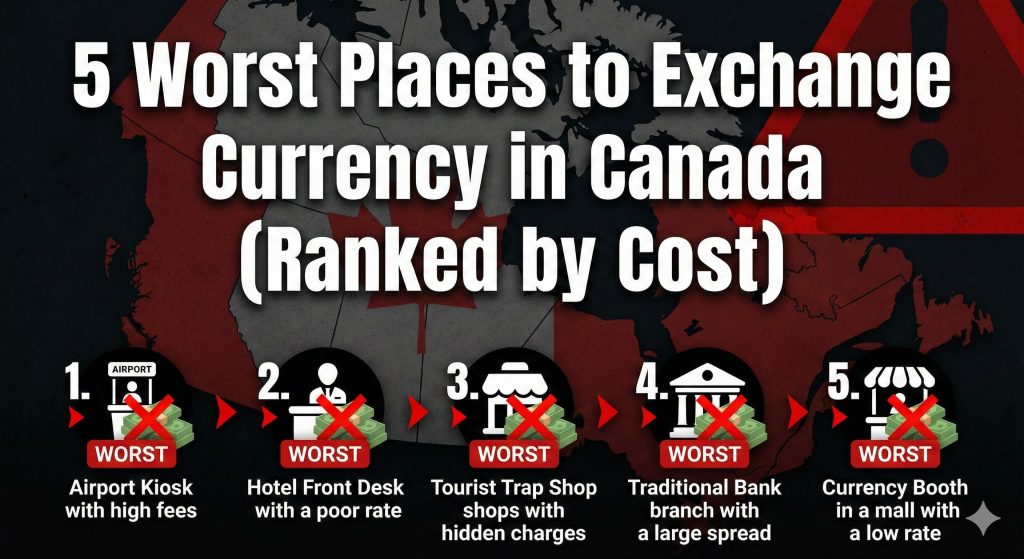
Not all currency exchange is created equal. The difference between the best and worst options can cost you 10% or more of your money—sometimes much more. Canadians often exchange currency wherever is most convenient, not realizing that convenience comes with a steep hidden price tag.
Here are the five worst places to exchange currency in Canada, ranked from bad to truly awful, along with what each one actually costs you.
#5: Major Banks (2.5%–3.5% Markup)
Banks are the baseline—the default option most Canadians use without thinking. They’re also worse than most people realize.
When you exchange currency at RBC, TD, Scotiabank, CIBC, or BMO, you don’t pay an explicit fee in most cases. Instead, you pay through the exchange rate. Banks add a markup of 2.5% to 3.5% above the mid-market rate (the rate banks use when trading with each other). That markup is their profit, invisible on your receipt.
On a $5,000 conversion, a 3% markup costs you $150. On $10,000, it’s $300. These aren’t hypothetical numbers—they’re what Canadians pay every day at their local branch.
Banks also charge wire transfer fees ($30 to $80 for international wires) and incoming wire fees ($15 to $17). If you’re receiving funds from abroad, the fees stack up quickly.
Why do banks rank as the “least bad” option on this list? Because at least they’re consistent and regulated. You won’t get scammed at a bank branch. You’ll just quietly lose money on every transaction without ever seeing a line item showing what you paid.
What you’re really paying: 2.5%–3.5% on every dollar exchanged, plus wire fees where applicable.
#4: Cruise Ship Currency Exchange (3%–5%+ Markup)
If you’re cruising out of Vancouver, Montreal, or anywhere on the Canadian coast, you might think exchanging currency onboard is convenient. It is—but that convenience costs significantly more than what banks charge.
Cruise ship exchange desks and onboard ATMs typically apply markups of 3% to 5% or higher. Some cruise lines charge an additional cash advance fee (often 3%) on top of the poor exchange rate. ATM withdrawals on cruise ships commonly carry fees of $5 to $10 per transaction, plus whatever your bank charges for out-of-network use.
The onboard currency on most major cruise lines (Royal Caribbean, Celebrity, Norwegian, Holland America) is US dollars regardless of where the ship is sailing. If you’re a Canadian who needs USD for onboard expenses plus local currency for ports of call, you’re paying conversion fees in multiple directions.
Norwegian Cruise Line eliminated onboard currency exchange entirely in 2024, forcing passengers to obtain foreign currency before boarding. Other cruise lines offer exchange services at Guest Services, but with limited currencies available and rates that favour the cruise line heavily.
What you’re really paying: 3%–5%+ markup, plus potential cash advance fees of 3% and ATM fees of $5–$10 per withdrawal.
#3: Hotel Currency Exchange (4%–8% Markup)
Hotels offer currency exchange because they know guests will use it. Travellers arrive late, are jet-lagged, and need local currency for a taxi or tip. The hotel desk is right there. This is exactly why hotels charge some of the highest markups in the industry.
Hotel exchange desks commonly apply markups of 4% to 8% above the mid-market rate. Some hotels advertise “no commission” while building their entire profit into the inflated exchange rate. The Government of Canada’s official travel advice specifically warns that “foreign exchange desks at airports and hotels” have fees that “tend to be very high” and may be “the most expensive places to change money.”
The problem is compounded when hotels offer to convert your bill into your home currency at checkout. This is dynamic currency conversion, and it adds another layer of fees (typically 3% to 8%) on top of an already unfavourable rate. The hotel can use any exchange rate they wish when performing this conversion—there’s no requirement to use the market rate.
If you’re staying at a Canadian hotel and an American guest asks to pay in USD, the hotel will happily accommodate them—while pocketing a significant spread on the conversion.
What you’re really paying: 4%–8% markup, sometimes higher. Dynamic currency conversion at checkout adds another 3%–8%.
#2: Airport Kiosks (5%–10% Markup)
Airport currency exchange is legendary for its poor rates, and the reputation is well-deserved. Kiosks at Toronto Pearson, Vancouver International, Calgary, and Montreal-Trudeau commonly charge markups of 5% to 8% above the mid-market rate, with some premiums exceeding 10% or more.
NerdWallet found airport exchange markups as high as 14% to 17% in their research. At those rates, exchanging $2,000 could cost you $280 to $340 in hidden fees—money that vanishes into the spread between what you receive and what your dollars are actually worth.
International Currency Exchange (ICE) operates the currency counters at many major Canadian airports, including Vancouver, Calgary, Montreal, and Ottawa. While ICE offers online pre-ordering with better rates than walk-up service, the in-person rates remain among the worst available anywhere.
Why are airport rates so bad? Limited competition, captive customers, and high operating costs (airport rent is expensive). The kiosks know you need currency now, you’re about to board a plane, and you have no other options in the departure lounge. They price accordingly.
The 24-hour airport kiosk is the most expensive currency exchange service operating in most Canadian cities. The only reason airports don’t rank as the worst option is that at least they’re transparent about what they offer. The next entry is worse because it actively deceives you.
What you’re really paying: 5%–10% markup on average, sometimes 15%+ for less common currencies or small transactions.
#1: Paying USD at Canadian Stores (Variable, Often 10%–15%+)
The single worst place to “exchange” currency in Canada isn’t an exchange service at all—it’s any Canadian retailer, restaurant, or service provider that agrees to accept US dollars.
When a Canadian business accepts USD from an American tourist (or from a Canadian who happens to have US cash), they set their own exchange rate. There’s no regulation, no disclosure requirement, and no transparency. The business can—and typically does—apply whatever rate benefits them most.
In tourist areas like Niagara Falls, border towns, and major cities, many businesses advertise that they accept US dollars. What they don’t advertise is the rate they’ll give you. Some apply exchange rates that are 10% to 15% worse than the actual market rate. Others treat USD and CAD as equal (“at par”) even when the Canadian dollar is worth significantly less—a practice that sounds generous but actually costs the USD holder substantially.
Change is where the real damage happens. Even if the posted prices are reasonable, you’ll almost always receive change in Canadian dollars at a rate the merchant chooses. The spread on that conversion can be enormous.
This isn’t technically currency exchange—it’s currency acceptance. But the effect on your wallet is the same, and usually worse. At least an airport kiosk shows you a rate before you commit. A restaurant cashier just hands you change and wishes you a nice day.
What you’re really paying: Completely variable—often 10%–15% or more, with no disclosure and no recourse.
The Common Thread: Convenience Costs Money
Every option on this list shares one characteristic: they’re convenient. Banks are everywhere. Hotels and cruise ships are where you’re already staying. Airports are where you depart. Retailers accept your cash on the spot.
That convenience is exactly what you’re paying for. Currency exchange providers know that when you’re rushed, tired, or out of options, you’ll accept whatever rate they offer. They price their services for customers who don’t have time to compare.
The alternative requires a few minutes of planning. Exchanging currency before you travel, using a specialized provider with competitive rates, comparing your options—these small steps can save hundreds of dollars on larger exchanges.
What Actually Works
If you want to avoid the worst options, here’s what to do instead:
For travel currency: Exchange cash before your trip using a dedicated currency exchange service. The rates are typically 1% to 2% above mid-market—a fraction of what airports and hotels charge. CanAm Currency Exchange guarantees to beat bank rates, and you can arrange everything before you leave.
For large transfers: Wire transfers through banks cost $30 to $80 plus the exchange rate markup. Specialized FX providers often include free wire transfers and offer rates 2% to 3% better than banks. On a $50,000 transfer, that’s $1,000 to $1,500 in savings.
For regular conversions: Cross-border workers, snowbirds, and business owners who convert currency monthly or weekly should establish a relationship with a currency specialist. Volume often qualifies you for better rates, and you’ll never find yourself resorting to airport kiosks or hotel desks.
The bottom line: the worst currency exchange options exist because people use them without comparing. A single phone call to CanAm or a quick rate check online can show you exactly how much these “convenient” options actually cost—and why a few minutes of planning is worth hundreds of dollars.